%20(600%20x%20120%20px)%20%E8%83%8C%E6%99%AF%E9%80%8F%E9%81%8E.png)


Tokyo in August 2026: A First-Time Visitor's Guide to Japanese Summer Traditions, Festivals & Kagurazaka
Updated: 2 days ago

Tokyo in August is Japan's peak summer month — the hottest, most humid stretch of the year, dense with fireworks festivals, bon odori dancing, and the nationwide Obon holiday exodus. This guide covers what a first-time visitor actually needs to know: the heat and typhoon season, Obon crowds, the year's biggest fireworks and dance festivals, and an evening in Kagurazaka built around all of it.
Before You Experience Tokyo in August, Understand Why It Matters
If you ask people who have visited Tokyo in August, most will tell you the same thing first: it is hot. Genuinely, seriously hot. But ask them what they remember a year later, and heat is rarely the answer. They remember the sound of a festival drum carrying across a canal, the paper lantern floating down a dark river, the quiet click of a fan being opened on a train platform.
That contradiction is the real story of Tokyo in August. It is the most physically demanding month to visit — and, for exactly that reason, the month in which Japanese culture reveals itself most openly. Fireworks, bon odori dancing, wind chimes, cooling summer robes, the quiet return of families to ancestral hometowns: none of these exist despite the heat. They exist because of it. Japan did not simply endure this season. Over centuries, it built an entire culture around living well within it.
This guide follows that idea. Before recommending what to do, we want you to understand why Tokyo behaves the way it does in August — its weather, its festivals, its most important family tradition, and the neighborhood, Kagurazaka, where all of it can still be felt in a single evening.

What Is Tokyo Like in August? Weather, Heat & What to Expect
If you are asking what is Tokyo like in August, the honest answer starts with the numbers. Based on the 2010–2025 average, Tokyo in August sees:
Average temperature: 28.2°C (82.8°F)
Average high: 32.5°C (90.5°F)
Average low: 25.1°C (77.2°F) — meaning even nighttime rarely brings real relief
Humidity: 75.8%
Rainfall: around 155mm, noticeably less than the 251mm typical of September
By early August, the rainy season is firmly behind Tokyo. The Japan Meteorological Agency confirmed the Kanto-Koshin region, including Tokyo, ended its rainy season on July 20, 2026 — one day later than average — with central Tokyo immediately recording 36.1°C, the year's first mōshobi. What follows is Japan's most intense stretch of heat: high temperatures paired with high humidity, and nights that rarely cool below 25°C (77°F). This combination is what locals mean when they describe Tokyo summer nights as "nettaiya" — tropical nights.
There is also a second factor to plan around: typhoons. According to Japan Weather Association forecasting released in June 2026, typhoon activity typically climbs through June and July before peaking in August, with landfalls most common in September. The 2026 outlook specifically flags an increase in typhoon approaches during August, with the possibility of stronger, more developed storms later in the season.
What catches many first-time visitors off guard is keikaku-unkyu (計画運休, "planned service suspensions") — a system in which Japanese railways announce cancellations in advance of a typhoon's arrival, rather than waiting for conditions to deteriorate before reacting. The practice has become standard only over the past decade or so; trains can stop running hours before the weather actually turns bad, and resume only once conditions are confirmed safe — which matters more in August than in most months, since the Obon exodus described below already has millions of people moving through the same stations and shinkansen lines you might be relying on.
Our own advice, from running tours through typhoon season for several years: avoid scheduling significant travel in the two to three days immediately before your international departure, and if a line is suspended, check the operator's own service status page (for JR lines, JR East's operational information page) before heading to the station (the operator will differ by line — for example, JR Central for the Tokaido Shinkansen).
This does not mean travel plans should be built around fear of typhoons — it means checking the week-ahead forecast, and knowing that a suspended line will resume once conditions are confirmed safe, is simply part of visiting Japan in August, the same way checking rain radar would be for any other destination.
So — is August a good time to visit Tokyo? If you are looking for comfortable, mild weather, honestly, no. But if you are willing to plan around the heat rather than fight it, August rewards visitors with something July does not yet have in full: the year's biggest festivals, the deepest cultural tradition of the summer calendar, and streets that empty out in a way that makes the city, paradoxically, easier to enjoy. We will get to all three.
For detailed guidance on what to pack, how to dress, and the cooling tools locals rely on, our full guide to surviving Tokyo's August heat covers it in practical detail. Here, we want to look at something different: not how to survive the heat, but how Japan learned, centuries ago, to live inside it.
How Japan Learned to Live with Summer
Long before air conditioning, Japan still had to get through summers like this one. What developed was not a set of survival tactics but something closer to an aesthetic — a way of making unbearable heat feel different, even when the thermometer did not change.
Uchimizu (打ち水), the practice of sprinkling water across a stone path or entranceway, is the clearest example. It does lower the immediate air temperature slightly through evaporation, but its real function was always more social than scientific: a wet path meant "someone cared enough to cool this ground before you walked on it." It is a small, quiet act of hospitality that Kyoto and Tokyo shopkeepers still perform outside their storefronts on summer mornings.
Furin (風鈴), the glass wind chime, works on the same principle from the opposite direction. It does nothing to the temperature at all. What it changes is what heat sounds like. A light, high chime in response to the smallest breeze reframes stillness and heat as something to notice rather than something to escape.

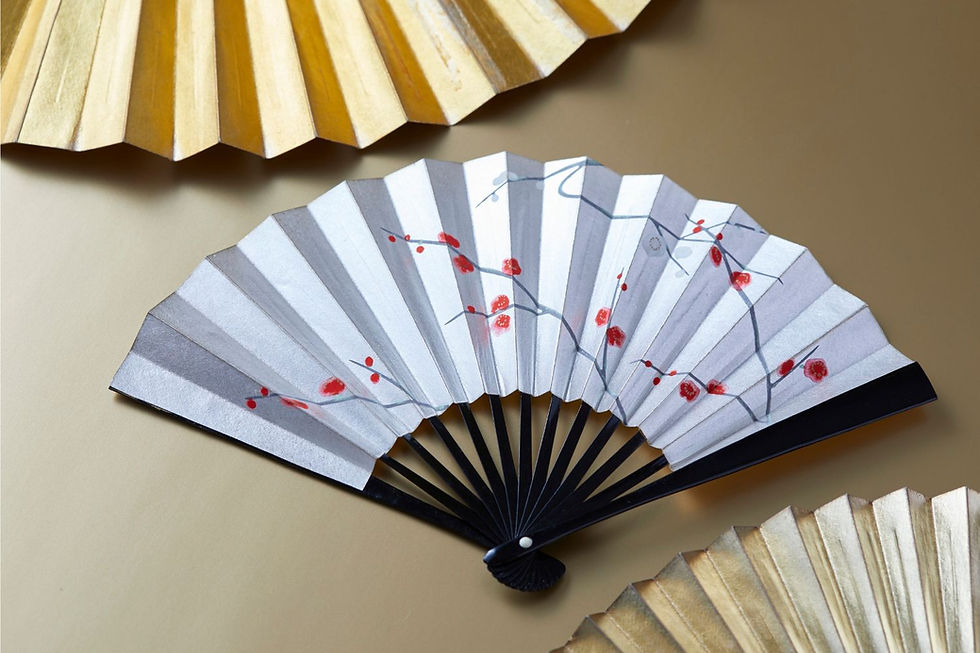
The same logic runs through the handheld fan (uchiwa) and folding fan (sensu), the woven bamboo blinds (sudare) hung to filter harsh sun while still allowing air through, and the tradition of yūsuzumi (夕涼み) — literally "evening cooling" — sitting outside in the hour after sunset specifically to let the heat of the day go. None of these tools solve the heat. They give people a ritual for enduring it gracefully, which, across centuries of Japanese summers, turned out to matter just as much.
This is the frame worth carrying into the rest of this guide: in Tokyo, summer heat was never treated as a problem to be eliminated. It was treated as a season to be lived inside, deliberately and with a certain amount of style.
Understanding Obon: The Heart of Japan's Summer
If there is one tradition that explains August in Japan more than any other, it is Obon.
Obon is a Buddhist observance built around a simple, powerful idea: for a few days each year, the spirits of ancestors return to visit their living family. It is not treated as frightening. It is treated as a homecoming.
The tradition follows a clear sequence:
Mukaebi (迎え火) — a "welcoming fire," traditionally lit outside the home, to guide ancestral spirits back
Shōryō-uma (精霊馬) — small figures made from cucumbers and eggplants, fitted with chopstick "legs," representing a fast horse to bring ancestors home quickly and a slow ox to see them off gently
Bon Odori (盆踊り) — community folk dancing, held in parks and streets across every neighborhood, historically performed to welcome and entertain the visiting spirits
Okuribi (送り火) and tōrō nagashi (灯籠流し) — the "farewell fire" and the floating of paper lanterns down a river, sending ancestral spirits back at the end of the visit

Why does this happen in the heat of summer, rather than in a milder season? Obon follows the old lunar calendar's seventh month, and in most of Japan today it is observed according to the "month-late" custom — in mid-August rather than mid-July — a shift that took hold after the switch to the solar calendar in the Meiji era. Nationally, in 2026, Obon falls on August 13 (Thursday) through August 16 (Sunday). A small number of areas, including parts of central Tokyo, still observe the older July Obon, from July 13 to July 16 — one of the quieter quirks of the calendar that can confuse first-time visitors checking dates.
For travelers, this creates a genuinely useful, counter-intuitive fact: because Obon is fundamentally about returning to one's ancestral hometown, millions of Tokyo residents leave the city during these four days. The result is not a capital overwhelmed by holiday crowds, but one of the few stretches of the year when central Tokyo's daily rhythm visibly slows down. Understanding why — that people are leaving to honor family, not because Tokyo itself empties for tourism reasons — is what turns a scheduling detail into something worth knowing before you arrive.
Our dedicated guide to the Obon holiday in Japan goes further into its origins and a smart itinerary around it.

Experience August: Tokyo's Best Summer Festivals
Obon is not the only tradition on Tokyo's August calendar — the city moves into its busiest festival season of the year around it. Rather than list dozens, we have chosen five that reward understanding their history, not just their photographs.
Fukagawa Hachiman Festival (深川八幡祭り) — August 12–16 Known as one of Edo's three great festivals, this is a special year: 2026 is a hon-matsuri, the largest of the three-year festival cycle, held once every three years. The centerpiece, on August 16, is the mikoshi rengō togyo — more than fifty ornate palanquins carried through the streets of Fukagawa in a single procession. Its nickname, the "water-throwing festival," comes from onlookers dousing the bearers with buckets of water, originally offered as a blessing for their safety and endurance.
Fukagawa carries two layers of history worth knowing. First, its shrine, Tomioka Hachimangū, is recognized as the birthplace of Edo kanjin-zumo — the officially sanctioned, fundraising sumo tournaments first permitted here by the shogunate in 1684, the direct ancestor of the sumo tradition still practiced today.

Second, the district itself was once home to the tatsumi geisha, named for Fukagawa's position southeast ("tatsumi") of Edo Castle. Tatsumi geisha were known for their unmistakably plainspoken, almost masculine style — plain kimono, bare feet even in winter, borrowed men's haori jackets, and stage names like "Otokichi" rather than conventionally feminine ones. They were celebrated as the embodiment of iki, the distinctly Edo aesthetic of understated, confident style, in contrast to the ornate glamour associated with Kyoto's geisha culture. Few places in Tokyo compress this much genuine Edo history — sumo, shrine culture, and geisha history together — into a single August weekend.
EDO KAGURA's founder Shinya Yamada began his career in Tokyo in Fukagawa, and has carried a mikoshi through these streets himself — soaked, like everyone else, by the crowd's buckets of water. It is a memory that makes the history above feel less like a history lesson, and more like something still very much alive. Few places in Tokyo compress this much genuine Edo history — sumo, shrine culture, and geisha history together — into a single August weekend.
Asagaya Tanabata Festival (阿佐谷七夕まつり) — August 7–11 Now in its 70th year, this festival fills the shopping streets around Asagaya station with enormous handmade paper decorations, some inspired by anime and pop culture alongside traditional Tanabata motifs. Its timing, just before Obon begins, marks a natural transition point in the month.
Jingu Gaien Fireworks Festival (神宮外苑花火大会) — August 8 One of the most accessible large-scale fireworks displays in central Tokyo, launching from 19:30 to around 20:30 near Meiji Jingu Gaien, with August 9 held as a rain-contingency date.
Shibuya Bon Odori (渋谷盆踊り) — August 8 Now in its seventh year, this event closes part of Bunkamura-dori and Dogenzaka to traffic and builds a yagura tower directly in front of Shibuya 109, inviting anyone nearby — resident or visitor — into the dancing circle. Its stated purpose is explicit: creating a shared space between Shibuya's community and the people visiting it, danced to a mix of original Shibuya songs and nationwide standards like Tokyo Ondo.
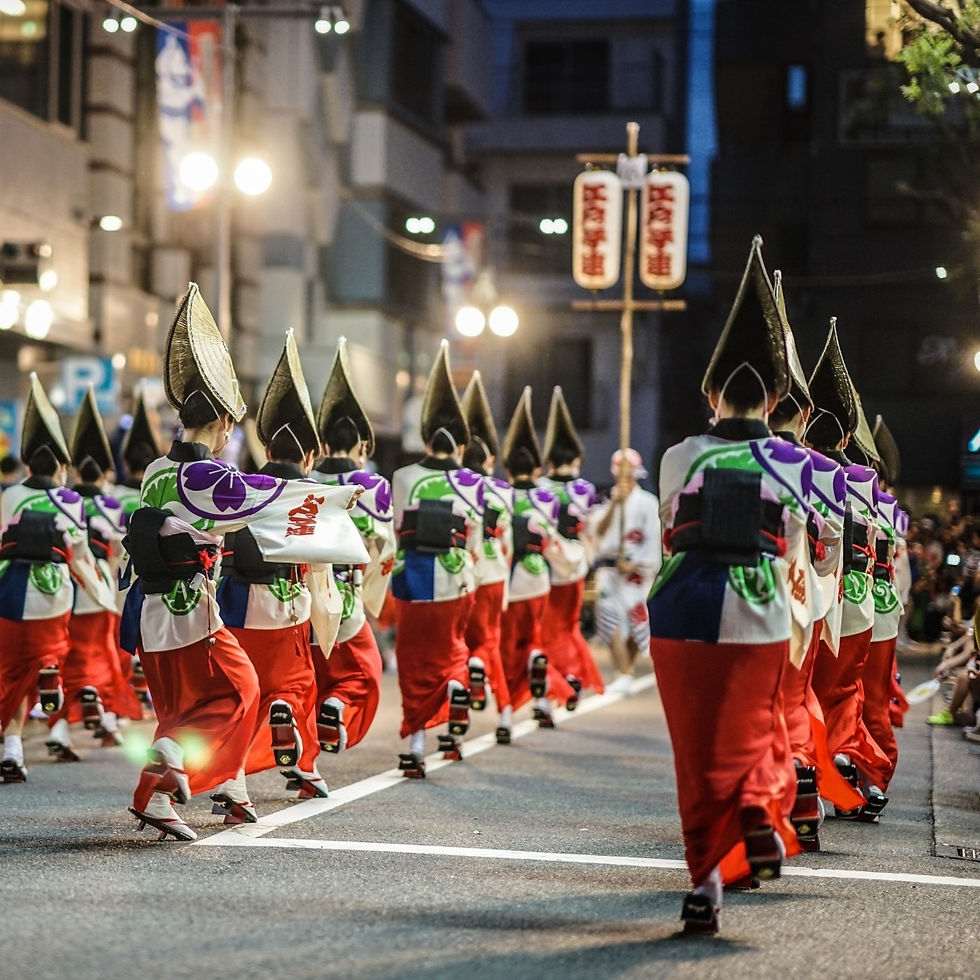
Koenji Awa Odori (高円寺阿波おどり) — August 29–30 Closing out the month, this is one of Tokyo's largest Awa Odori events, bringing thousands of dancers from dozens of teams into the streets of Koenji over two evenings.
For those curious about smaller, neighborhood-level bon odori, Tokyo Daijingu Shrine, close to Kagurazaka, holds its own bon odori celebration each August — a confirmed annual event, though its exact 2026 dates had not yet been announced at the time of writing.
Summer Foods: Tasting the Season
Japanese summer cooking follows the same underlying logic as uchimizu and furin: it is not simply about calories or nutrition, it is about how food can change how heat feels.
Hiyashi somen and hiyashi chuka — chilled thin noodles, served over ice with a light dipping sauce — turn a hot meal into a cold, refreshing one without sacrificing the ritual of a proper lunch.
Kakigori, shaved ice piled high and drizzled with syrup, has moved well beyond the simple strawberry-flavored version many visitors expect; contemporary Tokyo kakigori shops now build elaborate versions with fruit purees, condensed milk, and matcha.
Unagi (eel), rich in fat and traditionally associated with stamina in the heat, remains one of the most historically significant summer foods in Japan — a dish believed capable of restoring strength lost to the season.
Tokoroten, a firm, nearly flavorless seaweed jelly served with vinegar or soy-based sauce, offers something closer to texture and coolness than taste, which is precisely its appeal in August's humidity.
Our full guide to Japanese summer foods goes deeper into where to find each dish and how it fits into the wider culture of eating with the season, not against it.

Escape the Heat — Or Discover Tokyo's Own Retreat
For travelers determined to get away from Tokyo's heat entirely, day trips to cooler destinations are a well-established option, and our guide to the best summer day trips from Tokyo covers routes worth the extra travel time.
But leaving the city is not the only way to find relief. Tokyo has its own retreat, and it does not require a train reservation: Kagurazaka, a historic neighborhood built along a gentle hill, where narrow stone-paved alleys, dense tree cover, and low-rise architecture create a noticeably cooler, quieter feeling than the exposed concrete of Tokyo's larger avenues — especially once the sun begins to set.

Kagurazaka in August: Where Understanding Becomes Experience
Here is what a single August day in Tokyo might look like, once you have understood the season rather than simply endured it.
Midday, when the heat is at its most punishing, is the right time to be indoors somewhere air-conditioned and worthwhile. Tokyo's museums are unusually well-suited to August: the Ota Memorial Museum of Art's Animals & Monsters ukiyo-e exhibition runs through August 23, the Tokyo Metropolitan Teien Art Museum's Lucie Rie retrospective continues through September 13, and the National Museum of Western Art's Rembrandt print exhibition runs through September 23 — all offering hours of cool, quiet viewing exactly when the streets outside are least comfortable.
By late afternoon, as the light softens and the temperature begins its slow evening decline, Kagurazaka itself becomes the destination. Walking its stone-paved slope — the same slope that has defined this neighborhood for generations — feels noticeably different from the exposed heat of the day. This is when the neighborhood's character comes forward: small shopfronts, quiet temple gates, the particular hush of a district that has never fully modernized its pace.
In the evening, Kagurazaka offers what few Tokyo neighborhoods can: genuine access to one of the city's last surviving traditional ryotei restaurants, complete with geisha entertainment, in an atmosphere built for exactly this kind of unhurried summer night. A dinner here — course after course of seasonal dishes, live shamisen, the practiced conversation of a geisha trained in this specific neighborhood's traditions, and, for those who wish, a pour of good sake — is not a performance staged for tourists. It is the same tradition Kagurazaka has hosted for generations, offered to guests willing to understand its context first.
This is the sequence this entire guide has been building toward: heat understood rather than resented, ancestors honored rather than glossed over, festivals appreciated for their history rather than only their spectacle, and an evening in Kagurazaka experienced as the natural conclusion of all of it — not as an advertisement bolted onto the end of a weather report.

2026 Travel Notes
Obon 2026: August 13 (Thu) – August 16 (Sun) nationwide; a small number of areas, including parts of central Tokyo, observe July Obon (July 13–16) instead.
Fukagawa Hachiman Festival: August 12–16, 2026 — a special hon-matsuri year, with the main mikoshi procession on August 16.
Asagaya Tanabata Festival: August 7–11, 2026 (70th edition).
Jingu Gaien Fireworks Festival: August 8, 2026 (rain-contingency date: August 9).
Shibuya Bon Odori: August 8, 2026.
Koenji Awa Odori: August 29–30, 2026.
Typhoon activity: Japan Weather Association forecasts an above-average number of typhoon approaches in August 2026, with the possibility of stronger storms later in the season — check short-range forecasts as your trip approaches.
What to wear in Tokyo in August: light, breathable fabrics such as linen and cotton, with a light layer for aggressively air-conditioned trains and department stores. Full packing guidance is in our heat survival guide.
Many visitors remember Tokyo's summer for its heat.
We hope you'll remember it for something deeper — for the fire lit to welcome ancestors home, for a festival whose history reaches back to the birth of sumo itself, and for an evening in Kagurazaka where all of it, finally, becomes something you experience rather than something you were simply told about.
Continue the Series: Understanding Japan, Month by Month
This guide is part of an ongoing series for first-time visitors to Japan, built around one idea: understanding a season always makes experiencing it more meaningful.
New monthly guides will be added as the series continues.
The Grand Sumo Tournament Starts Next Month
The September 2026 Tokyo Grand Sumo Tournament runs September 13–27 at Ryogoku Kokugikan. General ticket sales open August 8 — but seats for popular dates sell out quickly.
Prefer official tickets already secured — with no queues and no resale risk? EDO KAGURA's September 16 experience may be your best option.
Shinya Yamada is the founder of EDO KAGURA and has lived in Kagurazaka for over 25 years. Before founding EDO KAGURA, he spent nearly three decades in investment banking and fund management. He began his career in Tokyo's Fukagawa district and has carried a mikoshi through its streets himself during the Fukagawa Hachiman Festival described above.

![What is the Obon Holiday in Japan? A Complete Guide to Traditions & Smart Itinerary [2026 Edition]](https://static.wixstatic.com/media/983a60_f51e47118ae449a4bc8453caa10b856c~mv2.jpg/v1/fill/w_980,h_980,al_c,q_85,usm_0.66_1.00_0.01,enc_avif,quality_auto/983a60_f51e47118ae449a4bc8453caa10b856c~mv2.jpg)
![How to Survive Tokyo's August Heat: A Guide to the Weather, What to Wear & More [2026 Edition]](https://static.wixstatic.com/media/983a60_a696bd47025245bea3e8a6458e4329a7~mv2.jpg/v1/fill/w_980,h_653,al_c,q_85,usm_0.66_1.00_0.01,enc_avif,quality_auto/983a60_a696bd47025245bea3e8a6458e4329a7~mv2.jpg)
Comments