


Tokyo in December 2026: A First-Time Visitor’s Guide to Winter Weather, Year-End Traditions & Kagurazaka
Updated: 1 day ago

December in Tokyo is easy to describe in a single word: clear. The air turns dry, the skies stay blue for days at a time, and winter brings some of the year's clearest views of Mt. Fuji. But December is also the month when Japan closes its year.
There are markets for New Year goods, temple bells at midnight, year-end parties in every neighborhood, and in the last few days of the year, a city where many businesses take a well-earned New Year break.
This guide covers the practical side first: weather, what to wear, events, and the late-December closures that catch many travelers off guard. It then explains why Tokyo's December looks the way it does.
The guide is written from Kagurazaka, the historic geisha district in the center of Tokyo, where our founder has lived for more than 25 years and where our team guides travelers every day.
Tokyo in December 2026: Quick Answer & Key Facts
Is December a good time to visit Tokyo? Yes, for most travelers, with one important caveat about the last week of the year.
December in Tokyo | |
Average high / low | 12.0°C / 3.8°C (54°F / 39°F) |
Rainfall | About 58 mm, one of the driest months of the year |
Sunshine | About 174 hours, with many clear days in a row |
Sunset | Around 4:30 pm all month |
Snow | Rare (on average less than one day of snowfall in December) |
Crowds | Comfortable through mid-December. From late December, major stations, Shinkansen, popular shopping areas and big shrines get very busy |
Biggest caveat | Many museums, shops and restaurants close from about Dec 29 to Jan 3 |
Weather figures: Japan Meteorological Agency, climate normals for Tokyo (1991–2020).
The good:
Reliable sunshine.
The last autumn leaves in early December.
Winter illuminations.
Some of the best Mt. Fuji views of the year.
Seasonal food at its best: hotpot, oden, and winter wagashi.
The less good:
Short days.
Cold evenings.
A late-December holiday period when transport gets crowded and many places close.
If you can choose, the first three weeks of December are the sweet spot.
Tokyo Weather in December: Temperature, Sunset & What to Wear
Why December is so dry and sunny
Tokyo's clear winter weather has a simple cause. In winter, cold northwesterly winds blow from the Asian continent across the Sea of Japan. They pick up moisture over the water and drop it as heavy snow on the mountains along Japan's western coast. By the time the air crosses the mountains and reaches Tokyo on the Pacific side, it has lost most of its moisture.
The result is the dry, bright weather Tokyo is known for in winter. This is also why the far side of the mountains can be buried in snow on the same day Tokyo has a cloudless sky. The same dry air is why Mt. Fuji, about 100 km away, is visible from the city far more often in winter than in the humid summer months.

Early, mid and late December
Period | Average high | Average low |
Early December (1–10) | 13.3°C | 5.3°C |
Mid-December (11–20) | 11.9°C | 3.6°C |
Late December (21–31) | 11.0°C | 2.5°C |
Early December is the mildest part of the month, and in many years the last autumn leaves are still out (see below).
Mid-December brings noticeably colder mornings.
Late December is the coldest part of the month on average, but also the sunniest. The cold, dry air that lowers the temperature is the same air that keeps the skies clear.
Sunset times in December 2026
Date | Sunset (Tokyo) |
December 1 | 4:28 pm |
December 15 | 4:29 pm |
December 31 | 4:37 pm |
Source: National Astronomical Observatory of Japan.
Darkness falls early, so plan outdoor sightseeing for the morning and early afternoon. Save the evening for illuminations, dinner, or one of the long-night experiences described later in this guide.
What to wear
Dress in layers you can take off rather than one heavy coat. Trains, shops and restaurants are well heated, so you will move between cold streets and warm interiors all day. A practical setup:
A warm coat
A sweater or fleece layer underneath
Comfortable walking shoes
A scarf and gloves for the evening
Many temples and traditional buildings are only lightly heated. If you plan to visit them, an extra layer and warm socks make a real difference, because you may be asked to remove your shoes.
Tokyo in Early December: The Last Autumn Leaves
In Tokyo, autumn color peaks later than most visitors expect. In a typical year, ginkgo avenues and maple gardens are at their best from late November into early December. This makes the first week of December a bonus season: you get autumn color and the first winter illuminations on the same trip.
Leaf timing shifts from year to year, so check the latest foliage reports shortly before you travel. If your trip falls in late November, our Tokyo in November guide covers the peak season in more detail.

Best Things to Do in Tokyo in December
If you only have a few days, here is the short list. Each item is covered in more detail below.
See the winter illuminations. Roppongi Hills, Marunouchi and Shibuya are the classic choices.
Visit a traditional year-end market. The hagoita (battledore) market at Senso-ji and the Setagaya Boro-ichi are the most famous.
Look for Mt. Fuji from an observation deck. On clear December days, decks such as Tokyo Skytree, Tokyo Tower and Shibuya Sky can show Fuji on the horizon. With sunset around 4:30 pm, a late-afternoon visit may reward you with its silhouette against the evening sky.
Visit one of Tokyo's big indoor attractions. teamLab Borderless (Azabudai Hills) and teamLab Planets (Toyosu) are immersive digital-art museums, and Warner Bros. Studio Tour Tokyo – The Making of Harry Potter in Nerima is a full day out for fans. All three are popular in December, so book ahead and check their year-end hours.
Experience Japan's unusual Christmas, from fried chicken to strawberry shortcake.
Eat winter food: oden, sukiyaki, shabu-shabu and seasonal wagashi.
Try an indoor cultural experience on a cold afternoon, such as ukiyo-e printing, zazen or wagashi making.
Spend an evening in Kagurazaka, where the year-end season fills the old geisha district with life.

December 2026 Events Calendar
Dates (2026) | Event | Where | Why go |
Nov 5 – Dec 25 | Keyakizaka Illumination (5–10 pm) | Roppongi Hills | About 970,000 blue-and-white LEDs, with Tokyo Tower at the end of the street |
Nov 12, 2026 – Feb 14, 2027 | Marunouchi Illumination | Marunouchi | Champagne-gold trees along Naka-dori, lit well beyond Christmas |
Nov 12 – Dec 25 | Marunouchi Bright Holiday | Marunouchi | Christmas trees and holiday events around Tokyo Station |
Early – Dec 25 (dates to be announced) | Ao no Dokutsu (Blue Cave) | Shibuya – Yoyogi Park | An avenue of trees lit entirely in blue |
Dec 14 (related events in the preceding days) | Ako Gishi-sai | Sengaku-ji Temple | Honors the 47 ronin on the anniversary of their raid |
Dec 15 – 16 | Setagaya Boro-ichi | Setagaya | A street market held since 1578 |
Dec 17 – 19 | Hagoita-ichi | Senso-ji, Asakusa | Thousands of decorated battledores for the New Year |
Dec 31 | Joya no Kane (temple bells) | Temples citywide | Bells rung 108 times at midnight |
Dec 31 – Jan 1 | Oji Fox Parade | Oji | A lantern-lit procession inspired by a Hiroshige print |
Dates may change. Please check each organizer's official page before you go.
Three events worth understanding
Setagaya Boro-ichi (Dec 15–16 and Jan 15–16). This market's history follows the rise and fall of a castle town. In 1578, Hojo Ujimasa, the lord of Odawara Castle who then ruled the Kanto region, opened a rakuichi in Setagaya, a market where merchants paid no market taxes and could trade freely. Markets like this were a way to draw merchants and goods to a growing town, and it was held six times a month.
When the Hojo were defeated by Toyotomi Hideyoshi and Setagaya Castle was abandoned, the town lost its purpose and declined quickly. The regular market faded away. In its place, an annual toshi-no-ichi, a year-end market for farm tools and New Year goods, took shape.
The name came much later. By the 1890s, old clothes and boro (rags) had become the main goods on sale, and people began calling it the "Boro-ichi" to match what was actually sold. The name was well established by the end of the Meiji era, and became official after World War II. Today about 700 stalls sell antiques, tools, plants and everyday goods. The market is held four days a year, on the same dates regardless of the day of the week: December 15–16 and January 15–16, from 9 am to 8 pm (Setagaya City). If you miss it in December, you can still catch it in January 2027 (Friday 15 and Saturday 16). The Daikan Gyoretsu, a costumed procession that recreates the Edo-period magistrate's patrol of the market, is held only once every five years. It is not part of the 2026–27 markets; the next one is planned for the 2027–28 season.
Hagoita-ichi at Senso-ji (Dec 17–19). The 18th of every month is the monthly festival day of Kannon, Senso-ji's principal deity, and December 18 is the last of the year, known as Osame no Kannon. In the Edo period, stallholders expected huge crowds for it, so on December 17 and 18 they gathered in the temple grounds to sell New Year goods and lucky charms. This became Senso-ji's toshi-no-ichi, or year-end market. It was the largest in Edo, with stalls said to have stretched from Asakusabashi all the way to Ueno.
From the late Edo period, more and more stalls sold hagoita, decorated wooden paddles for the New Year shuttlecock game. They were already good-luck charms. The feathered shuttlecock looks like a dragonfly, an insect that eats other insects, so it was said to "eat" the bad insects believed to bring illness. The hard black seed at its tip is called mame, and since mame ni kurasu also means "to live in good health," it carried a wish for a healthy life. As the custom of giving hagoita to families with a newborn daughter spread, the paddles became the stars of the market, and it came to be called the Hagoita-ichi (Senso-ji).
Today dozens of hagoita stalls line the grounds. When a paddle is sold, the seller leads a lucky round of rhythmic clapping, sanbon-jime, for the buyer, and the banter between craftsmen and customers entertains everyone nearby.
Oji Fox Parade (Dec 31–Jan 1). An old Oji legend tells that on New Year's Eve, foxes gathered from far and wide under a great tree, changed into their formal attire (shōzoku), and then went together to pay their respects at Oji Inari Shrine. The small shrine beside that tree is still called Shozoku Inari. The ukiyo-e master Utagawa Hiroshige painted the gathering in his series One Hundred Famous Views of Edo.
On New Year's Eve in 1993, local people followed Hiroshige's print and walked together to Oji Inari Shrine for their first shrine visit of the year. That modest procession became the Fox Parade, and the 34th parade will be held on New Year's Eve 2026 (official site). Participants walk through the streets in fox masks and makeup, carrying lanterns. It is a rare chance to see an ukiyo-e print come to life. If it sparks your curiosity, our ukiyo-e woodblock printing experience lets you try the traditional woodblock printing technique behind these famous prints.

Japanese Christmas: Why Fried Chicken and Strawberry Cake?
Christmas in Japan is not a public holiday, and for most people it has no religious meaning. Yet the season is everywhere: illuminations, Christmas markets, and above all two very particular foods.
Fried chicken. Japan's Christmas fried chicken is often credited to a single campaign, and that campaign did matter. In 1974, KFC Japan launched its national "Kentucky for Christmas" promotion. According to the company's own account, the idea came from hearing foreign customers say they missed turkey at Christmas. Turkey was very hard to find in Japan.
But the custom stuck for several reasons, not one:
Roast chicken was already becoming a popular Christmas dish in Japanese homes.
Fried chicken was easy to pick up on the way home, which mattered on a normal working day.
Years of advertising made it feel like a tradition.
Today many families order their Christmas chicken weeks in advance.
Christmas cake. The Japanese Christmas cake is a light sponge with cream and strawberries. Yet Japan's first Christmas cake looked very different. In December 1910, just a month after opening its first shop in Yokohama's Motomachi, the confectioner Fujiya began selling a Christmas cake (Fujiya company history). It is often described as a fruitcake with sugar icing, closer to the British tradition than to today's version.
Fujiya added strawberry shortcake to its range in 1922, but the shortcake only became the standard Christmas cake after World War II. Christmas sales became a fixture of department stores in the 1950s, and during Japan's rapid economic growth in the late 1950s and early 1960s, department stores and Western-style bakeries competed hard for the Christmas market. A strawberry shortcake, topped with whipped cream or buttercream, became the cake families across the country bought for Christmas. Its red and white also echo kōhaku, Japan's traditional colors of celebration.
Christmas Eve is treated more like a romantic evening for couples than a family holiday. Expect restaurants in popular areas to be fully booked on December 24.

Year-End Traditions: How Edo Customs Live On in Modern Tokyo
Japan's New Year is the most important holiday of the year, and December is the month of preparation. Many customs you will see in modern Tokyo have roots in the Edo period (1603–1868). Some have changed shape along the way, and others are more recent.
Big cleaning (ōsōji). Edo Castle held an annual susu-harai, sweeping away a year's soot before the New Year. In the early Edo period it took place around the 20th of the twelfth month. The date is commonly said to have been moved because the 20th of every month had become a memorial day for the third shogun, Tokugawa Iemitsu, who died on the 20th day of the fourth month. The 13th was chosen instead because it fell on kishuku-nichi, a day considered auspicious for any undertaking.
Once the castle cleaned on the 13th, samurai households, merchants and townspeople followed, and the whole city of Edo came to clean on the same day. December 13 is still known as shōgatsu kotohajime, the day New Year preparations begin, and the year-end deep clean remains a household ritual today.
Year-end markets and gifts. The toshi-no-ichi markets where Edo residents bought New Year goods survive in events like the hagoita market. December is also the season of oseibo, year-end gifts sent to people who helped you during the year. Department stores set up whole floors for them.
Year-end parties (bōnenkai). The word toshi-wasure, "forgetting the year," appears as early as 1430, in the diary of Prince Fushimi-no-miya Sadafusa, where aristocrats gathered at year's end for linked-verse (renga) poetry to put the year's troubles behind them. A later war chronicle describes the Hojo lords of Odawara Castle, the same family that founded the Boro-ichi, holding a year-end poetry gathering and banquet every December 30th, where rank was set aside and the drinking went on until dawn.
Over the Edo period the custom spread from aristocrats and samurai to ordinary townspeople. The word bōnenkai became common in the Meiji era. Its spread is often linked to government officials receiving year-end bonuses and to students who stayed in the city over the holidays. By 1905 the word appears in Natsume Soseki's novel I Am a Cat.
Today a bōnenkai is a gathering of coworkers, clients or friends to close the year together. In December, izakaya and restaurants across Tokyo are full of these parties, especially on Friday nights.
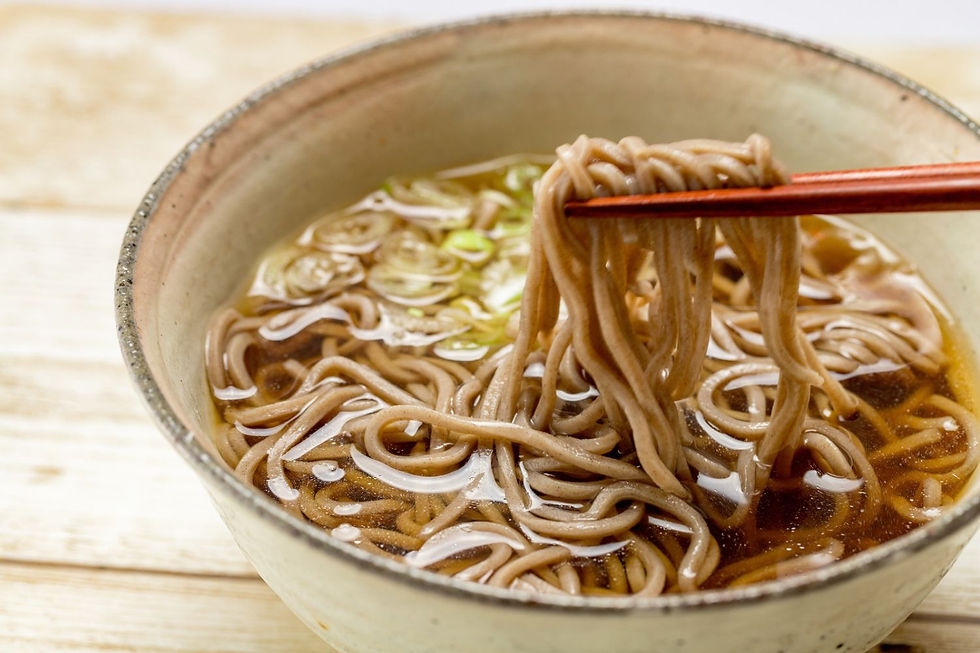
Toshikoshi soba (Dec 31). Many families eat buckwheat noodles on New Year's Eve. A popular explanation is that the noodles cut easily, symbolizing a clean break from the year's hardships, while their length stands for a long life.
Winter solstice and the yuzu bath (Dec 22, 2026). On the shortest day of the year, many households and public baths float yuzu citrus in the bath, a custom believed to ward off colds through the winter.
Joya no kane (Dec 31). At midnight, temples ring their great bells 108 times. In Buddhism, 108 is the number of worldly desires and troubles, and each strike lets one of them go before the new year.
Late December Guide: Closures, Crowds & Transport
The last week of the year is where most December trips go wrong. This is not because Tokyo is closed, but because some of it is, on dates that vary from place to place.
Why the closures happen. By law, December 29 to January 3 are holidays for government offices. Many companies and facilities follow a similar winter break, so it is the most common closing period in Japan. It is not universal, though: large shopping malls, department stores, convenience stores and many major attractions stay open, sometimes with shorter hours.
What to expect:
Museums: Many close for several days. For example, the Tokyo National Museum is closed December 26–31, 2026.
Small shops and restaurants: Family-run places often close for several days around the New Year.
Shinkansen: From December 25, 2026 to January 5, 2027, every Nozomi train between Tokyo and Hakata on the Tokaido and Sanyo Shinkansen runs with reserved seats only. Hikari and Kodama trains still have non-reserved cars. Reserved tickets go on sale one month before travel, so book early (JR Central).
Crowds: Congestion is concentrated in specific places, not the whole city. Expect the heaviest crowds at major stations, on long-distance trains, in popular shopping areas and at major shrines over New Year. Many residents leave Tokyo to visit family, so some residential neighborhoods feel quieter than usual.
Shrines and temples: Very busy from New Year's Eve through the first days of January for hatsumōde, the first shrine visit of the year.
Our advice: if your trip overlaps December 29–January 3, check each place's official calendar before you go. Plan the experiences that matter most to you for earlier in the month.
EDO KAGURA's year-end schedule:
Kagurazaka walking tours and izakaya tours can run through the year-end period, depending on guide availability. Please ask us early.
Ukiyo-e woodblock printing is available until December 30.
Zazen meditation is available until December 28.
Our other experiences close earlier in late December for the season.
From January 1 to 3, all experiences are closed.

Indoor Cultural Experiences for Winter Days
On a cold afternoon, or once the sun goes down at 4:30 pm, a hands-on cultural experience is one of the most rewarding ways to spend time in Tokyo. You learn something, you meet the people who keep the tradition alive, and you leave with a story that no illumination can give you.
Ukiyo-e woodblock printing: Print your own image with the same layered technique used for Hiroshige's and Hokusai's prints.
Wagashi workshop: Learn from a Tokyo Meister confectioner. December is a beautiful season for wagashi, with designs inspired by winter and the coming New Year.
Tea ceremony: A quiet bowl of matcha is the perfect counterpoint to a busy December city.
Kumihimo braiding: Braid silk cord with a long-established kumihimo house.
Zazen meditation: Sit in a real temple as the year draws to a close. Temple halls can be cold in winter, so dress warmly.
Noh experience at Yarai Noh Theater: An introduction to Japan's oldest surviving theater art, in a historic stage in Kagurazaka.
Most of these experiences close for the season in late December. If they are on your wish list, book for the first three weeks of the month.

Long Winter Nights in Kagurazaka
Short days have one great advantage: long evenings. Kagurazaka is at its best after dark. Lanterns glow along narrow stone-paved alleys, the shopping street prepares for the New Year, and the old ryōtei restaurants come alive.
A neighborhood where you can watch the New Year being prepared
Kagurazaka is not only office buildings. It is still a neighborhood of detached houses and small, stand-alone izakaya, and at the end of the year many of them put up kadomatsu (pine-and-bamboo gate decorations) and other New Year ornaments at their entrances. In a city where most people live and work in tall buildings, it is one of the few places in Tokyo where you can see New Year preparations up close, on the doorsteps of real homes and shops.
These decorations are not just festive. Kadomatsu are traditionally understood as markers that guide the toshigami, the deity of the new year, to each home. That is why they stand at the entrance rather than inside.
On our December walking tours, we often notice guests' expressions soften as they pass these doorways. Many tell us that seeing a Japanese neighborhood quietly preparing for the New Year was one of the moments they remember most.
Geisha culture at the end of the year
For Kagurazaka's geisha, December is a lively month. Companies and long-time patrons hold year-end banquets, and the district fills with the sound of shamisen from behind closed doors.
Yet from inside the kagai (geisha district), we can tell you that the busiest month of the year for geisha is January, not December. Geisha are considered bearers of good fortune, so people want them at the very first celebrations of the new year. In January, geisha also wear their most formal attire, a black crested kimono, for the New Year season.
If you hope to experience a geisha ozashiki evening in Kagurazaka, plan for the first three weeks of December and contact us as early as possible. If you will still be in Japan in January, expect evenings to be even harder to secure. Our Tokyo in January guide explains the New Year season in more detail.
Izakaya in bōnenkai season
December is when Japan's izakaya are at their most energetic. They are also at their most crowded, and the busiest places are often fully booked with year-end parties.
Timing makes a big difference. Most bōnenkai are work gatherings, so they cluster on Friday nights, when people do not have to work the next morning. If you want a better chance of getting into popular places, aim for Monday to Wednesday, or Saturday, when fewer office parties are held.
This is also when going with someone who knows the neighborhood really pays off. On our Kagurazaka izakaya tour, a local guide takes you into the kind of small, welcoming places that are hard to find, and hard to enter, on your own. Izakaya tours can run through the year-end period, subject to guide availability.
An evening walk
After dinner, a walk through Kagurazaka's back lanes and past the grounds of Akagi Shrine shows a quieter side of December Tokyo. Instead of dazzling illuminations, you see the soft light of lanterns and traditional houses. Our Kagurazaka walking tour introduces the history behind these streets.

Day Trips from Tokyo in December
If you have a spare day, December's clear weather suits these trips:
Lake Kawaguchiko: Close-up views of a snow-capped Mt. Fuji.
Hakone: Hot springs, mountain views, and Fuji on clear days.
Kamakura: Temples and the Great Buddha, quieter in winter.
Nikko: Shrines in winter scenery. It is much colder than Tokyo, so dress accordingly.
Avoid traveling out of Tokyo between about December 28 and January 3 if you can, when trains and highways are at their busiest.
Frequently Asked Questions
How cold is Tokyo in December? Average highs are around 12°C (54°F) and lows around 4°C (39°F). Days are often pleasant in the sun, and evenings are cold.
Does it snow in Tokyo in December? Rarely. According to the Japan Meteorological Agency, Tokyo averages less than one day of observed snowfall in December, and about three days each in January and February. These figures count any snowfall, including flakes that melt on landing, so even on a snowy day the city seldom turns white.
What should I wear in Tokyo in December? A warm coat over easy-to-remove layers, plus a scarf and gloves for the evening. See the weather section above.
Is Tokyo crowded in December? The first three weeks are comfortable. In late December, crowds build at major stations, on the Shinkansen and in popular shopping areas, and major shrines are packed for the first shrine visits of the New Year. Restaurants in popular areas are also fully booked on Christmas Eve.
Is everything closed on New Year's Eve and New Year's Day? No, but many museums, small shops and restaurants close from about December 29 to January 3. Check each venue's official calendar. See our late-December guide above.
Is December a good time to visit Japan? Yes. Clear skies, seasonal food, winter illuminations and year-end traditions make it one of the most rewarding months, especially in the first three weeks.

Continue the Series: Understanding Japan, Month by Month
This guide is part of an ongoing series for first-time visitors to Japan, built around one idea: understanding a season always makes experiencing it more meaningful.
New monthly guides will be added as the series continues.
About the Author
Shinya Yamada is the founder and Representative Director of EDO KAGURA, a cultural experience company whose work centers on Kagurazaka, Tokyo — a neighborhood he has called home for over 25 years. Deeply embedded in Kagurazaka's hanamachi (geisha district) community, he maintains direct relationships with its geisha, ryotei owners and traditional artisans, who often turn to him for guidance on welcoming international guests.
How to Access Kagurazaka
Kagurazaka is a historic neighborhood in central Tokyo, inside the Yamanote Line loop, and easy to reach by train or subway.
Kagurazaka Station: Tokyo Metro Tozai Line
Ushigome-kagurazaka Station: Toei Oedo Line
Iidabashi Station: JR Chuo-Sobu Line, plus several subway lines
From these stations, you can explore Kagurazaka's shopping street, narrow stone-paved alleys, temples and geisha district on foot. For travelers who want to discover the stories behind these streets, EDO KAGURA offers guided cultural experiences led by people with deep local knowledge.


Comments