%20(600%20x%20120%20px)%20%E8%83%8C%E6%99%AF%E9%80%8F%E9%81%8E.png)


How to Get Tokyo Sumo Tickets in September 2026 (Complete Guide & Sold-Out Options)
Updated: 6 hours ago
UPDATE — September 20: Our September 16 Grand Sumo Tournament Tour has now taken place, and September 2026 tickets are sold out. We hope to offer similar tours in 2027, if we can secure official tickets. Guests on our Priority Waitlist will receive advance notice before reservations open to the general public. → Join the Priority Waitlist
Planning to watch sumo in Tokyo in 2027? See our new guide, How to Get Sumo Tickets in Tokyo 2027 — Official Sales Dates & Insider Tips, covering official sale dates, pre-sale lotteries, seat types, and what to do if tickets sell out.
The September 2026 Tokyo Grand Sumo Tournament runs from September 13–27 at Ryogoku Kokugikan. General ticket sales opened on August 8, and all official tickets sold out on the same day.
This guide explains how the official ticket system worked for the September 2026 tournament, what happened during the sale, and what options remained after tickets sold out.
Why Tokyo Sumo Tickets Are Harder to Get Than You Think
Most visitors assume that buying sumo tickets works like buying tickets for any other event. It does not.
The Grand Sumo Tournament is one of Japan's most sought-after live experiences, held only six times a year across four cities. Tokyo hosts three of those tournaments annually: in January, May, and September. Demand has reached the point where tickets now sell out on the first day of general sales — not just for popular dates, but for entire tournaments across all fifteen days of competition.
The July 2026 Nagoya Tournament sold out on all dates. The September 2026 Tokyo Tournament general sale opened on August 8 and sold out the same day. The November 2026 Kyushu Tournament in Fukuoka sold out on September 19 — the first day of general sales. This pattern now repeats across every tournament, every year.
Opening day, weekends, and the final day — known as Senshuraku — have always attracted the highest demand. What has changed is that even weekday seats in the upper tier are now gone within hours of going on sale.
Getting a ticket is hard enough. Understanding what you are watching is harder. But we will come to that.
The Official Way to Buy Tokyo Sumo Tickets
The Japan Sumo Association operates an official online ticket service called Ticket Oosumo, available in English. This is the most reliable way to purchase tickets directly.
One piece of insider information that most visitors never discover: pre-sale dates for each tournament are announced well in advance — often more than a year before the event. At EDO KAGURA, we have been tracking these dates for years. For the September 2026 Tokyo Tournament, the general sale opened on August 8, 2026 — and sold out on the same day.
For future tournaments, we recommend creating your Ticket Oosumo account well in advance of the sale date. When tickets go on sale, they can disappear within hours — as the September 2026 general sale demonstrated.
Once purchased, tickets can be collected at any Seven-Eleven convenience store in Japan using the confirmation details sent to you by email.
Two important warnings about your ticket:
First, if you purchase a QR-code ticket, screenshots and printouts are invalid. You must present the live QR code directly from the Ticket Oosumo website or the distributed URL. A screenshot will not work at the gate.
Second, if you search for sumo tickets on the App Store, you may find an app called "SUMO Tickets." This app is for events in Argentina and has nothing to do with the Japan Sumo Association or the Grand Sumo Tournament. Do not use it.

Tokyo Grand Sumo Tournament Dates in 2027
In 2027, Grand Sumo Tournaments will be held at Ryogoku Kokugikan in Tokyo in January, May and September. Each tournament lasts 15 days.
Tournament | Dates |
January | January 10–24, 2027 |
May | May 9–23, 2027 |
September | September 12–26, 2027 |
Tickets sell out quickly after the general sale opens, so create your Ticket Oosumo account well in advance.
When official channels sell out, the temptation to use resale sites is understandable. Before you do, read this.
The Japan Sumo Association specifically warns that the following sites are not authorised ticket vendors for the Grand Sumo Tournament:
viagogo
BuySumoTickets
StubHub
ticketstreet
ticket ryûtsû center
Yahoo Auctions and Mercari
The Japan Sumo Association specifically warns that tickets purchased through unofficial sites may be refused entry at the arena. Only tickets issued on paper or as official QR-code tickets through authorised channels will be accepted.
Real Trouble Cases Documented by the Japan Sumo Association
The following are real cases reported to the Association:
"The ticket I bought on these sites was fake."
"I could not receive my ticket."
"They could not accommodate cancellations."
"The price was more than twice as much as on the official website."
And perhaps the most instructive case: "I purchased a Masu Box for four people from this site, and ended up sharing the box seat with other customers I had never met."
That last case deserves a moment of attention. Masu box seats are sold as a single unit for four people. When unofficial resellers split and re-sell individual seats within a single box, you may arrive to find strangers sitting beside you — centimetres away — for the entire duration of the tournament. This is not a hypothetical. It is a documented reality reported to the Japan Sumo Association.

Understanding Tokyo Sumo Ticket Types and Seating
There are several types of seating at Ryogoku Kokugikan. Here is a complete comparison based on the Japan Sumo Association's official price list.
Seat Type | Weekday | Weekend / Holiday | Notes |
Tamari (Ringside) | ¥20,000 | ¥20,000 | Age 16+ only. No food, drink, or phones. |
Masu S (Floor Box) | ¥14,000/person | ¥15,000/person | Sold as a 4-person unit. Sitting cross-legged on cushions. |
Masu A (Floor Box) | ¥12,000/person | ¥13,000/person | Sold as a 4-person unit. Sitting cross-legged on cushions. |
Masu B (Floor Box) | ¥10,000/person | ¥10,500/person | Sold as a 4-person unit. Sitting cross-legged on cushions. |
Masu C (Floor Box) | ¥8,500/person | ¥9,500/person | Sold as a 4-person unit. Sitting cross-legged on cushions. |
Chair S | ¥9,000 | ¥9,500 | Comfortable chair. Upper tier. |
Chair A | ¥8,000 | ¥8,500 | Comfortable chair. Upper tier. |
Chair B | ¥5,000 | ¥5,500 | Comfortable chair. Upper tier. |
Chair C | ¥3,500 | ¥4,000 | Most accessible price. Clear view from every seat. |
Wheelchair | ¥8,000 | ¥8,000 | Dedicated accessible seating. |
All prices include consumption tax. Source: Japan Sumo Association official price list (updated November 2025).
Tamari seats (ringside) place you as close to the dohyo as it is possible to sit. The atmosphere is extraordinary. However, guests must be sixteen or older, food and drink are prohibited, and mobile phones must remain out of sight. These seats are for those who already know sumo well.
Masu box seats are the traditional option — groups of four sitting cross-legged on cushions on a tatami-style floor, closer to the ring than the upper levels. Many visitors romanticise this experience in advance and find it unexpectedly uncomfortable after several hours. The resale site trouble case mentioned above — strangers sharing a box — is a direct consequence of how masu seats are structured and sold. Each box is designed for four specific people; when resellers split and redistribute individual places within a single box, the result is exactly the kind of awkward, uncomfortable experience the Association has documented.
Chair seats are located in the upper tier. Ryogoku Kokugikan was designed as a bowl-shaped arena. The view of the dohyo remains remarkably clear even from the upper tier. You will also be sitting in a comfortable chair for the full session — which, for an afternoon that runs to early evening, matters more than many visitors anticipate. For international visitors attending for the first time, chair seats represent the most comfortable and practical choice. Those who wish to bring binoculars or a camera with a zoom lens are welcome to do so.
BOX seats are sold as a private unit rather than individual seats, accommodating four to five guests with a table. They are well suited to groups who want a more private setting.

What to Expect on the Day of Your Tokyo Sumo Experience
Knowing the schedule before you arrive transforms the experience.
The arena opens in the morning, with lower-division bouts running throughout the day. The atmosphere builds gradually. By the time the top division appears, the crowd has reached full intensity.
Time | What Happens |
8:00 onwards | Doors open. Lower division bouts begin. |
14:45 | Juryo division ring-entering ceremony |
15:00 | Juryo division bouts |
15:55 | Makuuchi ring-entering ceremony |
16:00 | Yokozuna ring-entering ceremony |
16:10 onwards | Makuuchi bouts |
Around 18:00 | Yumitori-shiki — the closing bow ceremony |
Most visitors with afternoon tickets arrive around 15:30, catching the Juryo bouts before the top division appears. This is the right approach — watching the Juryo wrestlers first gives your eye a chance to calibrate before the Makuuchi wrestlers take the dohyo.
Essential Etiquette
Do not stand up during a bout. Sumo bouts are often decided in seconds. Standing up blocks the view of everyone behind you at the critical moment.
Flash photography is prohibited. The sudden burst of light distracts wrestlers during a moment of intense concentration.
Food and drink from outside the arena are not permitted. The Kokugikan has its own food stalls inside, including the famous Kokugikan yakitori — grilled chicken skewers produced in the arena's own basement kitchen — as well as bento boxes and drinks.
In 2026, the Japan Sumo Association introduced baggage inspection at the entrance. Allow a little extra time when arriving.
If you need to leave the arena temporarily, a transparent stamp on your hand allows one re-entry before 17:00.

From Our Experience: What We Have Learned After Decades of Attending
Arrive around 15:30 — not earlier, not much later.
The arena opens in the morning, but the atmosphere in the lower divisions is quiet. Arriving at 15:30 puts you in your seat just as the Juryo bouts are reaching their final matches. You feel the crowd beginning to lean forward. Then the Makuuchi ring-entering ceremony begins, and everything changes. This gradual build — from Juryo to Makuuchi to the Yokozuna — is one of the great pleasures of live sumo. Arriving too early means waiting through hours of sparse crowds. Arriving too late means missing the moment the arena comes alive.
September in Tokyo is still summer.
The September tournament takes place during what the Japanese call zansho — the lingering heat of late summer. Even in mid-September, temperatures inside Ryogoku Kokugikan can be warm, particularly on days when the arena is at full capacity. Light, breathable clothing is strongly recommended. A small folding fan is a practical addition. The arena is air-conditioned, but with thousands of people filling every seat, the temperature rises throughout the afternoon.
Allow more time than you think from Ryogoku Station.
Ryogoku Kokugikan is a two-minute walk from Ryogoku Station on the JR Sobu Line. On a normal day, this is straightforward. During the tournament, the streets around the arena fill with spectators, vendors, and sumo stable supporters. On busy days — particularly opening day, weekends, and the final weekend — allow at least five to ten minutes from the station to the gate. If you are arriving to meet a group at a specific time, add a buffer.
Buy the yakitori early.
Ryogoku Kokugikan is one of the only sports arenas in the world with its own underground chicken processing facility. The yakitori sold inside the arena is produced fresh in the basement kitchen and is one of the most talked-about aspects of the live experience. It is genuinely good — and it sells out. If you want to eat it during the bouts, buy it when you arrive rather than waiting until you are hungry. By the time the Makuuchi bouts begin, the most popular items are often gone.
You may encounter wrestlers in the streets.
Several active sumo stables are located in the Ryogoku neighbourhood. During the tournament, wrestlers travel to the arena on foot or by car, often passing through the surrounding streets in the mid-afternoon. On our walks through the area, we have come across wrestlers arriving for the day — an encounter that requires no planning and no ticket. It simply happens. If you are walking through Ryogoku before entering the arena, keep your eyes open. The experience of seeing a rikishi in person, outside the formal context of the tournament, stays with you.
Do not forget your re-entry stamp.
If you plan to leave the arena and return — to pick up food nearby, or simply to step outside — make sure to get a transparent stamp on your hand at the entrance gate before you leave. Re-entry is permitted once, before 17:00. The stamp is easy to miss if you are focused on finding your seat. Ask for it at the gate on your way out.

Before You Watch — Why Understanding Sumo Makes the Experience Unforgettable
Here is something that most sumo guides will not tell you.
Thousands of visitors attend the Grand Sumo Tournament every year. They watch the bouts. They see the wrestlers win and lose. They applaud. And then they leave.
Most of them could not tell you why the referee carries a short sword. Most could not explain what the salt purifies, or why the wrestlers stomp the earth before a bout, or why the yokozuna enters the ring flanked by two other wrestlers — one carrying a sword, one walking ahead to clear the way.
Most visitors leave the arena having watched sumo. They know who won. Few understand why.
Sumo is not simply a sport. It is a Shinto ritual that has been performed continuously for more than 1,500 years. Every gesture on the dohyo — the stomping, the salt, the referee's dagger, the bow ceremony that closes each day — carries a meaning that reaches back to Japan's oldest written records.
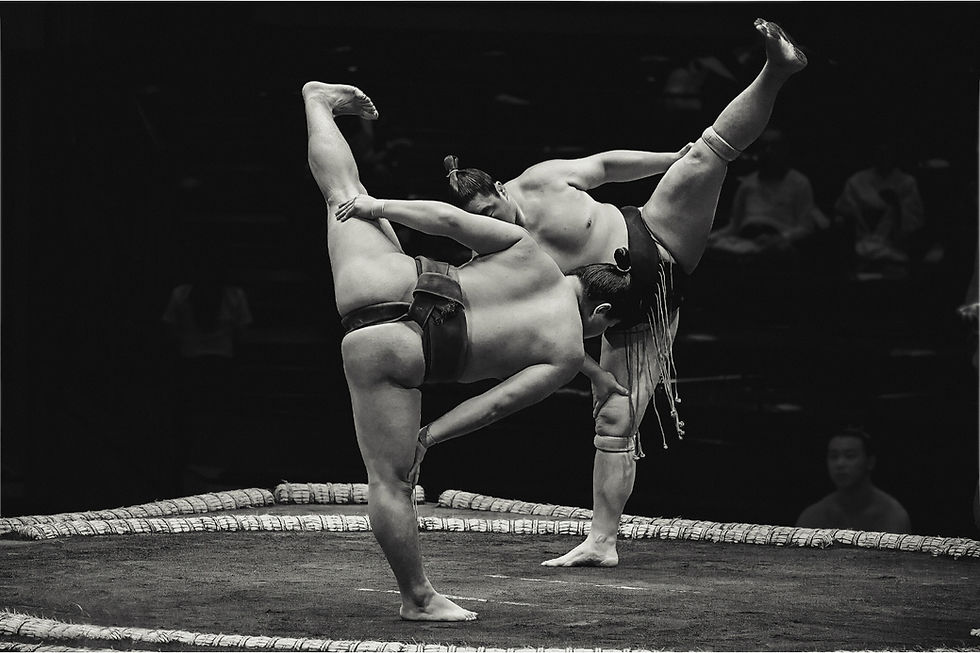
Push-out and force-out account for approximately half of all bouts in professional sumo. Understanding why requires reading the moment of contact — the angle of the body, the position of the hands, the shift of weight in the instant the wrestlers collide.
As a judo black belt and lifelong sumo enthusiast, EDO KAGURA founder Shinya Yamada explains why many bouts are effectively decided at the moment of impact — and how to see it happening in real time. This is not something that can be learned from a guidebook. It comes from decades of following professional sumo, and from understanding the body mechanics that sumo and judo share at their core. This is what the EDO KAGURA experience is designed to give you: the context to understand what is in front of you, before you sit down to watch it.
Even today, it is not unusual to see members of Kagurazaka's geisha community attending the Grand Sumo Tournament. In Edo, wrestlers and geisha were the two great figures of popular culture. Both were celebrated in ukiyo-e prints and followed by the public much as celebrities are today. Kagurazaka and Ryogoku are connected by eleven minutes on the JR Sobu Line. The EDO KAGURA Grand Sumo Tournament Experience is offered as part of Kagurazaka & Beyond — Special Edition, bringing together two of Edo's most enduring cultural traditions in a single day.
For travelers who want to understand Japan, not just see it.
All ticket prices and tournament information are sourced from the Japan Sumo Association's official website and price list. Information is subject to change. Please confirm the latest details at the Japan Sumo Association's official website before making any purchase. The September 2026 Tokyo Grand Sumo Tournament is now sold out. For future tournaments, we recommend joining our Priority Waitlist to be notified as soon as tickets become available.
Want to understand sumo more deeply before you watch?
We have written three more guides to help you get the most out of your tournament experience.
→ Why Do Sumo Wrestlers Throw Salt? Understand Japanese Culture Through Sumo — The Shinto ritual, Buddhist history, and Edo culture behind sumo's most famous gesture
→ How to Watch Sumo in Tokyo Like a Japanese Fan: 10 Things That Make Every Bout More Exciting — From the referee's live blade to the grip that decides every bout
→ Things to Do in Ryogoku Before Watching Sumo: A Walking Guide for True Sumo Enthusiasts — Active sumo stables, the 47 Ronin, and the spiritual heart of sumo, all within walking distance of Ryogoku Kokugikan
Planning to attend in 2027 or 2028? Read our updated guide: How to Get Sumo Tickets in Tokyo 2027 — Official Sales Dates & Insider Tips
Planning your whole trip around the tournament?
→ Tokyo in September 2026: A First-Time Visitor's Guide — weather and typhoon season, this year's rare Silver Week crowds, and the harvest festivals happening around the same dates


Comments