%20(600%20x%20120%20px)%20%E8%83%8C%E6%99%AF%E9%80%8F%E9%81%8E.png)


Why Do Sumo Wrestlers Throw Salt? Understand Japanese Culture Through Sumo
- Shinya Yamada
- Jun 7
- 21 min read
Updated: Jun 8

Every sumo bout begins the same way.
The wrestler walks to the corner of the ring, reaches into a wooden box, and throws a handful of coarse salt into the air. Some wrestlers throw it in a single elegant arc. Others hurl it toward the ceiling in a dramatic cloud that draws gasps from the crowd. A few scatter it quietly, almost privately, as if offering it to someone only they can see.
Then they do it again. And again. Sometimes five or six times before the bout begins.
By the end of a single day at Ryogoku Kokugikan, approximately 45 kilograms of salt will have been thrown across that ring.
Most visitors notice the salt immediately. Few understand what it means. And that gap — between seeing and understanding — is the difference between watching sumo and truly experiencing it.
Salt is the entry point to something much larger. Behind that handful of coarse sea salt lies 1,500 years of Shinto mythology, a Buddhist temple that built professional sumo, the samurai ethics encoded in the referee's blade, and the Edo entertainment culture that connected wrestlers and geisha in ways that still echo today.
This article uses the salt as a starting point. By the end, you will not only understand why sumo wrestlers throw salt. You will understand Japan differently.
Why Do Sumo Wrestlers Throw Salt? The Answer Most Visitors Miss
Sumo wrestlers throw salt to purify the ring — to drive evil from the sacred ground of the dohyo before two men compete on it. But that answer, correct as far as it goes, immediately raises a deeper question: why does salt purify anything? Why, in a country of a thousand traditions, does this particular one involve throwing large quantities of coarse sea salt onto a clay ring before every single bout?
The answer lies not in sumo, but in the oldest layers of Japanese spiritual life. The dohyo is not simply an arena. It is consecrated ground. What happens on it is, by the standards of Japanese religious practice, a sacred performance — and the salt is the opening act of that performance.
Most visitors watch sumo and see salt. Few understand what it means — and what it reveals about Japanese culture as a whole.
Why Salt Purifies — The Shinto Meaning of Kegare and Misogi
The Meaning of Kegare — Refreshing the Lifeforce
To understand why sumo wrestlers throw salt, you first need to understand a concept that has no direct equivalent in English.
The word is kegare. It is often translated as "impurity" or "pollution," but these translations mislead more than they clarify. According to the Jinja Honcho (Association of Shinto Shrines) — Japan's central Shinto organisation — kegare is better understood through its written characters: ke meaning life force or vitality, and gare meaning withered or exhausted. Kegare is not dirt. It is the depletion of life force. It is what happens to a person, a place, or a moment when vitality drains away.
Death is the most extreme form of kegare. So is serious illness. So is the aftermath of violence, disaster, or prolonged suffering. In each case, something essential has been lost — and the loss can be felt, transmitted, and accumulated in spaces as much as in people.
This is why sumo wrestlers do not simply step into the ring and fight. The ring must first be restored to a state of full vitality. The salt is the instrument of that restoration.
The Myth of Izanagi — Where Salt Gets Its Power
The spiritual authority of salt in Japan reaches back to the country's oldest written records.
In both the Kojiki, compiled in 712 AD, and the Nihon Shoki, completed in 720 AD, the god Izanagi returns from Yomi — the underworld — after the death of his wife Izanami. He has witnessed death at its most raw, and he carries the kegare of that encounter on his body. To purify himself, he immerses himself in the sea. In that act of immersion in seawater, the kegare is washed away and his vitality is restored.
From this mythological origin came the Shinto practice of using salt — the concentrated essence of the sea — as a cleansing and restorative agent. Salt does not merely clean. It restores. It returns a depleted space or person to a state of full, living vitality.
This is why salt appears throughout Japanese spiritual life: at shrines, at funerals, at the entrances to homes and restaurants where small mounds of salt are still placed today. And it is why, at every sumo bout, coarse salt — not refined table salt, but unprocessed sea salt that retains the full mineral character of the ocean — is cast across the dohyo before each match begins.

The Sacred Dohyo — Why the Ring Itself Must Be Purified
The Dohyo-Matsuri — Consecrating the Sacred Clay
The salt thrown during bouts is the most visible act of purification. But it is not the first.
The day before each tournament begins, a ceremony called the dohyo-matsuri takes place at Ryogoku Kokugikan. Presided over by the senior referee in the role of chief priest, offerings are buried in the centre of the ring: rice, salt, dried cuttlefish, dried chestnuts, kombu seaweed, and sake — the same categories of offering made at Shinto ground-breaking ceremonies throughout Japan.
These are not decorative gestures. They are gifts to the spirits of the earth, acknowledgments that the space about to be used is sacred, and requests for the protection of those who will compete on it. The dohyo, once consecrated, belongs to a different order of reality than the seats surrounding it.

The Full Ritual Flow — Salt, Shiko, Chiri-chozu, and the Tachiai
Understanding the salt requires understanding what surrounds it. Each bout is preceded by a sequence of ritual actions that together constitute a single continuous ceremony.
The wrestler first receives chikara mizu — strength water — rinsing his mouth to purify himself from within. He then performs chiri-chozu: squatting low, extending both arms to the sides with palms turned upward, demonstrating to the gods and his opponent alike that his hands hold no weapons. He throws salt. He stamps the earth — the shiko — driving evil from the ground beneath his feet. He settles into the shikiri crouch, facing his opponent across the white line. And then, when the moment comes, he rises into the tachiai — the explosive first contact that begins the bout.
Each of these actions has its own meaning. Together, they transform what might otherwise appear to be two men preparing to push each other out of a circle into something considerably more ancient: a ritualised contest performed on consecrated ground.

Beyond Salt — Four Sacred Rituals Most Visitors Never Notice
The Sumo Yokozuna Rope — A Sacred Symbol on the Dohyo
The thick white rope that only a yokozuna is permitted to wear during the ring-entering ceremony is one of the most visually striking elements of a sumo tournament. Most visitors assume it is ceremonial ornamentation. It is not.
The rope — the tsuna — is a shimenawa: the same sacred rope that marks the boundary between the sacred and the ordinary world at Shinto shrines across Japan. It appears on the great torii gates of shrines, wrapped around sacred trees and rocks, stretched across the entrances to inner sanctuaries. Wherever a shimenawa appears, it announces that the space within or before it belongs to the divine.
Made from hemp — a material understood in Shinto practice to repel evil — and weighing between five and twenty kilograms depending on the individual yokozuna's preference, it is hand-braided by members of the wrestler's own stable. The right to wear it was historically granted by the Yoshida Tsukasa family, a lineage that has governed sumo's ceremonial traditions for more than 800 years.
The yokozuna's presence reinforces the sacred character of the dohyo. The rope is the mark of that consecration.
During the ring-entering ceremony, the yokozuna is accompanied by two other wrestlers: the tachi-mochi, who carries a real Japanese sword as a symbol of the yokozuna's samurai-era status, and the tsuyuharai, whose title — "dew sweeper" — derives from a role in ancient imperial court ceremonies. The three wrestlers enter as a single ceremonial unit.

The Sumo Referee Sword — A Samurai's Oath of Judgment
The referee who stands in the ring during a sumo bout is called the gyoji. He wears the formal dress of a samurai official from the Kamakura and Muromachi periods — a garment called the hitatare, paired with a lacquered court hat called the eboshi. He carries a gunbai: the wooden war fan originally used by samurai generals to direct troops in battle, now used to indicate the winner of each bout.
At his left hip, the most senior referees carry a short blade.
This blade is not symbolic in the way that most ceremonial objects are symbolic. It is a live blade — 22 centimetres in length — classified as a genuine weapon under Japanese law. Its presence in the arena requires formal permission from the Tokyo Metropolitan Public Safety Commission under Japan's Firearms and Swords Control Law. The permission is granted, tournament after tournament, because the blade is understood to serve a legitimate ceremonial function that has been continuous since at least the Edo period.
The historical reason for its presence is straightforward. In the era when sumo was formalised as a professional sport, the referees who officiated bouts were samurai — warriors for whom wearing a sword at all times was both a legal right and a professional obligation. The gyoji of that period wore blades because they were samurai, and samurai always wore blades. As the 33rd and 35th holders of the title Kimura Shonosuke — the senior referee position in professional sumo — have both explained in their own words: the sword is the trace of those samurai origins, preserved because sumo preserves everything.
The blade carries a specific meaning: should a gyoji make a serious error of judgment — known as sashichigae — he is understood to bear the ultimate personal responsibility for that decision. The blade at his hip is a declaration of that responsibility: in the tradition of the samurai who once held this role, it signifies his readiness to take his own life should his judgment prove wrong. In practice, no gyoji has been required to do so. But the custom that follows a sashichigae remains: the gyoji submits a formal letter of resignation to the Japan Sumo Association. Whether it is accepted is another matter. The submission, however, is not optional — and the blade at the hip is the reason why.

Shiko Stomping — Banishing Evil Spirits from the Underground
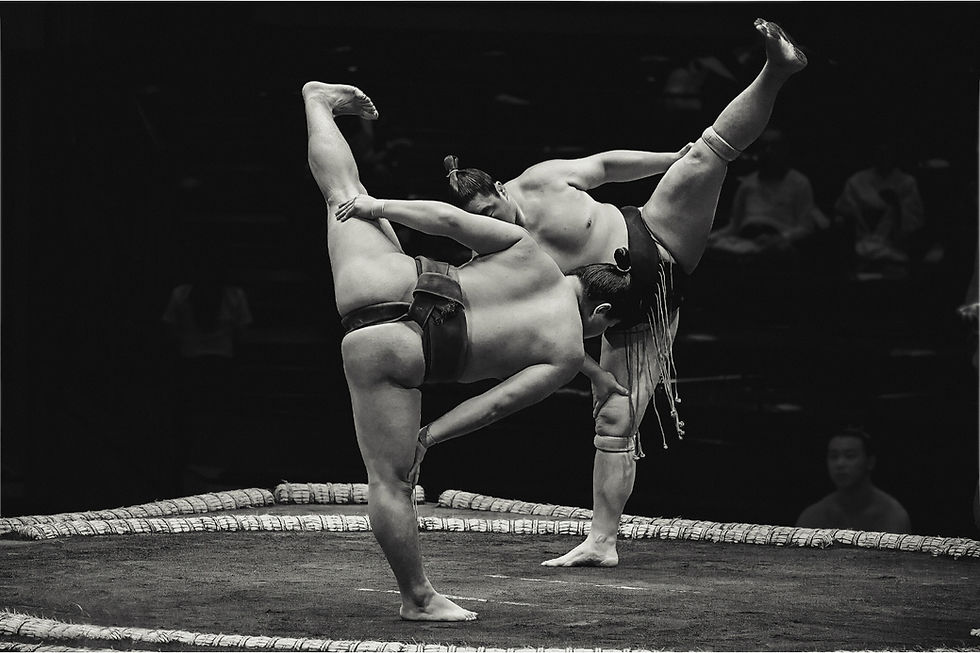
The shiko — the slow, deliberate act of raising one leg high and driving the foot into the earth — is frequently described to visitors as a warm-up exercise. It is that, but only incidentally.
The primary purpose of shiko is exorcism. The act of stamping powerfully into the ground is understood to drive evil spirits from the earth beneath the ring, and to summon the protection of the gods below. The four directions — east, west, north, south — are addressed in sequence. In ancient Japanese agricultural practice, this same gesture was performed to purify the soil before planting, to pray for a good harvest, and to invite divine blessing into the land.
Some wrestlers have elevated shiko into an art form in its own right. Kotoeihou — a wrestler whose shiko draws sustained applause from the arena before a single blow has been thrown — raises his leg perfectly straight, holds it at the apex for a moment that seems suspended in time, then drives it into the clay with a force that resonates through the seats. When Kotoeihou performs shiko, the crowd responds before the bout has even begun. If he is competing on the day you attend, watch for it.
As a physical practice, shiko is also remarkably effective training. The movement develops the hip flexors, inner thigh muscles, lower back, and core — precisely the muscle groups that determine a wrestler's stability and explosive power in the ring.
Showing Empty Hands — Chiri-chozu Before the Bout
The gesture called chiri-chozu, or chiri-wo kiru, — performed by each wrestler before his bout, with arms extended and palms turned upward — is one of the oldest ritual gestures preserved in Japanese martial culture.
The gesture comes from a time when demonstrating empty hands to one's opponent and to the gods who witnessed the contest was a necessary precondition of honourable combat. It is also an acknowledgment that the bout is not merely a physical competition. It is a ritual offering. The wrestlers present themselves — unarmed, purified, ready — to whatever forces are understood to preside over the dohyo.
The Paradox of Sumo — How Shinto Rituals Were Nurtured in Buddhist Temples
The Eight Million Gods — Why Japan Accepted Buddhism
Most English-language guides describe sumo as a Shinto tradition. This is accurate, but incomplete. The full story of sumo's spiritual history requires understanding something distinctive about Japanese religious culture: its capacity to hold multiple traditions simultaneously without experiencing them as contradictory.
Shinto is built around the concept of yaoyorozu no kami — eight million gods, a number that conveys not a precise count but an infinite, encompassing divine presence. Mountains, rivers, ancient trees, and ancestors all carry spiritual significance. This worldview is, by its nature, inclusive rather than exclusive.
When Buddhism arrived in Japan from the Korean peninsula and China in the sixth century, Shinto did not resist it. Instead, the two traditions merged — a process known as shinbutsu-shugo, or the syncretism of Shinto and Buddhism — and remained deeply intertwined for more than a millennium. This history is essential to understanding sumo, because the institution that shaped professional sumo into what it is today was not a Shinto shrine. It was a Buddhist temple.
Kanjin-Sumo — The Charitable Origins of Edo Tournaments
The direct ancestor of the Grand Sumo Tournament was a fundraiser.
Kanjin sumo — literally "sumo to encourage donation" — was a form of charitable wrestling held to raise money for the construction and repair of Buddhist temples and Shinto shrines. Wrestlers performed before the gates of religious institutions, drawing crowds whose donations funded sacred architecture across Edo Japan.
The first officially sanctioned kanjin sumo in Edo took place in 1684 at Fukagawa Hachiman Shrine. By the late eighteenth century, with the rise of star wrestlers including the fourth yokozuna Tanigaze, the fifth yokozuna Onogawa, and the celebrated Raiden, sumo had become one of the great popular entertainments of the city, comparable in cultural prominence to kabuki.
Eko-in Temple — The 75-Year Sanctuary of Grand Sumo
For 75 years, the permanent home of professional sumo in Edo was not a purpose-built arena. It was a Buddhist temple.
Eko-in, located in what is now the Ryogoku district of Tokyo, was founded in 1657 to memorialize the victims of the Great Meireki Fire — a disaster that killed more than 100,000 people. Beginning in 1833, when the Honbasho was formally established at Ryogoku, Eko-in became the regular venue for professional sumo. It remained so until Ryogoku Kokugikan opened in 1909.
The temple still stands, a short walk from the current arena. Monuments to deceased wrestlers remain on its grounds. When we walk through Ryogoku on EDO KAGURA tours, Eko-in is always the first stop. Without it, the Grand Sumo Tournament as it exists today would not exist.
The Ritual of Dohyo-Matsuri — Where Two Faiths Blur
Even the dohyo-matsuri — the ring consecration ceremony performed before every tournament — transcends the boundary between the two traditions. In form, it is a Shinto ritual: the offerings, the purification, the chief priest role taken by the senior referee. In origin, it belongs to an institution whose very existence owes itself to Buddhist fundraising, conducted in a city whose sumo history was made inside a Buddhist temple.
Sumo does not resolve this complexity. It embodies it. The dohyo-matsuri is not a Shinto ceremony that happens to take place in a Buddhist context. It is a Japanese ceremony — one that draws on both traditions because, in the world that produced it, both traditions were always already present.
The Numbers Behind the Salt — 45 Kilograms Every Single Day
45 Kilograms Per Day — The Scale of the Sacred
The salt thrown during a single day of tournament sumo at Ryogoku Kokugikan weighs approximately 45 kilograms. Over a fifteen-day tournament, the total approaches 675 kilograms.
This is not refined table salt. It is coarse sea salt — ara-jio — processed minimally from seawater to retain the full mineral character of its oceanic origin. The purifying power attributed to salt in Shinto practice derives specifically from its connection to the sea. A salt that has been refined and stripped of its oceanic character would be, in this context, a diminished thing.
The scale of salt use reflects something important about how sumo treats its ritual obligations. This is not a token gesture. It is a genuine commitment, renewed 45 kilograms at a time, every day of every tournament.
Why Only Senior Wrestlers Are Allowed to Throw Salt in Sumo
Salt throwing is the exclusive right of sekitori — wrestlers who have reached the rank of juryo or above, placing them in the top two divisions of professional sumo.
Wrestlers in the lower divisions do not throw salt before their bouts. For young wrestlers working their way up through the ranks, the right to throw salt is one of the most visible markers of having achieved sekitori status — of having crossed the threshold that separates the vast majority of professional wrestlers from the elite group whose names appear in large characters on the official ranking sheet.
A brief note on one recent change to sumo's prize economy: from the May 2025 tournament onward, the cash that winning wrestlers receive on the dohyo from kensho changed format. Previously, wrestlers received 30,000 yen in cash on the spot. From 2025, citing security concerns and logistical burden on staff, this was reduced to 10,000 yen handed over in person, with the remainder managed through official channels. The change reflects sumo's ongoing negotiation between deep tradition and practical modernity.
Every Wrestler Throws Salt Differently
Within the ritual, there is considerable room for personality.
The late Mitoizumi was famous for throwing salt in enormous quantities, launching it toward the arena lights in spectacular arcing clouds that brought cheers from the crowd. Others treat the salt with quiet deliberation: a small handful, released with precision, with the focused stillness of someone performing an act of genuine prayer rather than stadium entertainment.
Both approaches are legitimate. The ritual form is fixed; the spirit in which it is performed is the wrestler's own.
Having attended many tournaments over several decades, what stays with me is not the most dramatic throws — though those are memorable — but the wrestlers who seem genuinely absorbed in the act. In those moments, the ritual ceases to look like ceremony and begins to look like what it has always been: preparation.
Tactics and Physics — Where Sacred Ritual Meets Martial Arts
As someone who has watched sumo for nearly fifty years and holds a black belt in judo, I have spent a great deal of time thinking about the relationship between the long pre-bout ceremony and the explosive violence of the tachiai that follows it. They are not in opposition. They are continuous.
The 50% Statistical Fact
Of the 188,205 top-division bouts recorded between January 2013 and the May 2026 tournament, two techniques account for approximately half of all outcomes.
Oshi-dashi — push-out — occurred 47,386 times, representing 25.18% of all bouts. Yori-kiri — force-out — occurred 46,902 times, representing 24.92%.
Together: 50.1% of all professional sumo bouts decided by the two most basic techniques in the sport.
This statistical reality puzzles visitors who expect sumo's 82 recognised winning techniques to distribute more evenly. The explanation requires understanding what actually happens in the first second of a match.

The One-Second Collision — A Judo Black Belt's Perspective
The connection between judo and sumo runs deeper than most visitors realise. Baruto — the Estonian-born ozeki who reached the second-highest rank in professional sumo — was a national judo champion in Estonia before entering the ring. The current yokozuna Hoshoryu was exposed to judo from an early age before finding sumo. This is not a coincidence. The two disciplines share a common foundation.
That foundation is grip.
In judo, the contest begins the moment two players establish their hold on each other's judogi. Everything that follows — the throws, the sweeps, the reversals — flows from the quality of that initial grip. A judoka who secures a dominant grip in the first second of contact has already, in the most meaningful sense, won. The remainder of the bout is the working out of an advantage already established.
Sumo operates on precisely the same principle. The tachiai — the explosive initial charge — is the moment when both wrestlers establish their grip on each other's mawashi, or position their hands for a pushing attack. In that first second of contact, the angle of collision, the height of each wrestler's centre of gravity, and the position of the hands determine who has the dominant grip or position. From that moment, the large majority of bouts are already decided.
The long pre-bout ceremony — the salt, the shiko, the repeated shikiri preparations that can extend for up to four minutes before the referee signals the start — is not padding. It is calibration.
During those minutes, each wrestler is regulating his breathing, reading his opponent's posture, adjusting his psychological state, and waiting for the moment when his internal sense of readiness aligns with his opponent's. The tachiai can only be effective when both wrestlers are ready simultaneously. The ceremony is, among other things, the mechanism by which that simultaneity is achieved.
When the charge comes, the outcome of most bouts is determined within the first second of contact. The angle of the initial collision, the height of each wrestler's centre of gravity, the position of the hands, and the direction of force applied in that first fraction of a second set conditions from which most wrestlers cannot recover.
This is why push-out and force-out dominate the statistics. These techniques do not require elaborate set-ups or reversals. They require a superior grip or body position in the first moment of contact, maintained and extended. A wrestler who achieves dominant positioning in the tachiai drives forward with his advantage. His opponent, already compromised, struggles to reverse conditions that were set against him from the opening instant.
Reversals do happen. A wrestler who loses the initial exchange can still recover — through a well-timed arm throw, a sudden lateral movement, or a technique that exploits an overcommitted opponent. But these reversals are the exception. The rule, in both judo and sumo, is that grip and position established at the moment of first contact determine the outcome.
Before each bout in our experience, I share what I am watching for — the hand position, the direction of the first drive, which wrestler is likely to secure the grip he wants. Then we watch together. The bout almost always develops exactly as the opening moment suggested it would.

Why Sumo Is the Closest Thing to Living Edo
This is perhaps the most remarkable fact about sumo: almost nothing has changed.
The chonmage topknot worn by every professional wrestler is the same hairstyle worn by samurai and Edo townspeople in the eighteenth century — and the only reason it still exists is that sumo was granted a formal exemption when the Meiji government issued its danpatsurei (order to cut hair) in 1871 as part of its westernisation programme. Every other profession abandoned the topknot within years. Sumo kept it, because sumo was already understood to be a living tradition rather than a contemporary fashion.
The banzuke ranking sheet — the official document listing every wrestler's position in the hierarchy — is written by hand, in a calligraphic style called sumo-moji developed specifically for this purpose, in which the size and weight of each character corresponds to the wrestler's rank. The most senior wrestlers appear in large, bold characters at the top; the most junior appear in letters so small they require close attention to read. It has been produced this way, on paper, in the same format, since the Edo period.
The kesho-mawashi — the embroidered ceremonial aprons worn by top-division wrestlers during the ring-entering ceremony — are among the most expensive garments produced in Japan today. Made from hakata-ori or nishijin-ori silk, they typically cost more than one million yen each; the most elaborate, decorated with gold thread, hand embroidery, or precious stones, can exceed ten million yen. Sponsors and supporters commission them as gifts to wrestlers they back. They are, simultaneously, sacred vestments and advertising banners — a combination that would have been entirely familiar to the Edo audiences who watched kanjin sumo raise money for temple construction.
The referee's costume — the hitatare formal robe, the eboshi lacquered hat, the war fan — is the dress of a samurai court official from six centuries ago, preserved unchanged because the role itself has not changed.
The ring-entering ceremony performed before each top-division session is the same ceremony that was performed in the late eighteenth century, when the shogun watched from his castle and the crowd pressed against the barriers outside. The shimenawa rope is the same. The four-coloured tassels hanging from the roof above the dohyo — representing the four seasons and the four cardinal directions — are the same.
When you sit in Ryogoku Kokugikan and watch a sumo tournament, you are not watching a recreation of Edo. You are watching Edo. The form has been maintained with such fidelity that the distinction between the original and the continuation has effectively dissolved.
This is what we mean when we say sumo is living Edo.

Sumo and Geisha — The Two Great Stars of Edo
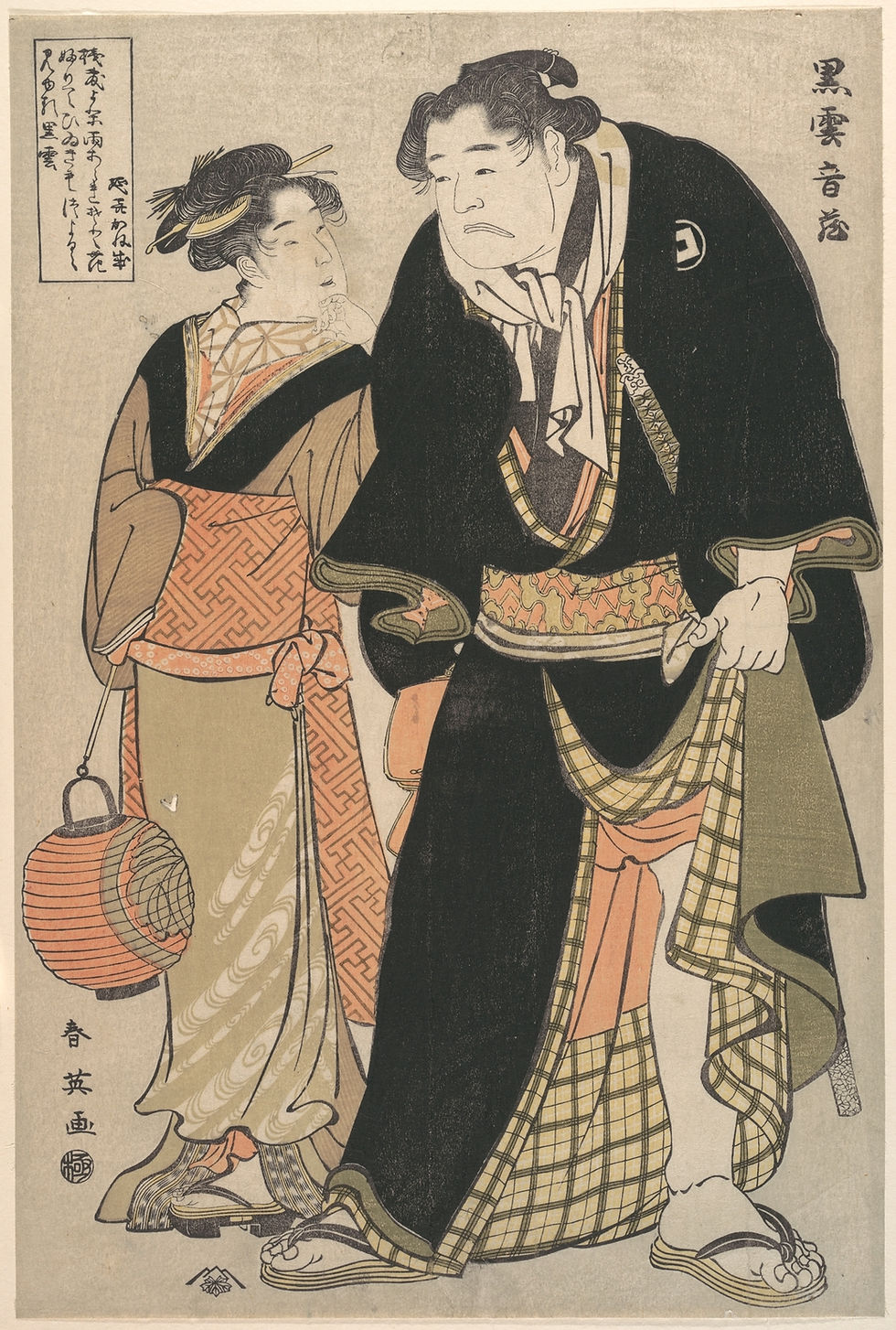
In the late eighteenth century, two categories of performer dominated the popular culture of Edo: kabuki actors and sumo wrestlers. Both were depicted in woodblock prints. Both attracted devoted followings among the merchant class. Both generated the kind of public fascination — romantic rumours between wrestlers and geisha, fierce rivalries between the greatest wrestlers of the day, celebrated personalities depicted in woodblock prints — that we now associate with professional sports and entertainment. In sumo, the contests between the fourth yokozuna Tanigaze and the fifth yokozuna Onogawa drew the kind of citywide anticipation that a championship bout generates today.
The connection between sumo and the geisha world was not coincidental. It was geographical.
The first officially sanctioned kanjin sumo in Edo took place in 1684 at Fukagawa Hachiman Shrine — the same neighbourhood that was home to the Tatsumi geisha of Fukagawa, known throughout Edo as the geisha of the deep river. The Tatsumi geisha were celebrated for embodying the spirit of iki — the Edo aesthetic of understated sophistication, cool restraint, and effortless elegance that defined the merchant culture of the city at its height. They were the geisha of the shitamachi, the low city, the part of Edo that produced its most vital popular culture.
Sumo and geisha shared not only the same neighbourhood but the same audience, the same patrons, and the same cultural moment. The wrestlers who competed at Fukagawa Hachiman Shrine and the Tatsumi geisha who entertained in the teahouses nearby were both expressions of the same Edo spirit — physical mastery, disciplined performance, and a deep connection to the traditions of the city. Their proximity was not accidental. It was the natural result of both traditions flourishing in the same soil.
This connection has not disappeared. During the Tokyo tournaments — held in January, May, and September at Ryogoku Kokugikan — the arena attracts visitors from across Tokyo's six geisha districts: Shimbashi, Kagurazaka, Akasaka, Asakusa, Mukojima, and Yoshicho. The sight of geisha in formal dress attending the sumo is sufficiently striking that NHK television regularly features it in tournament coverage.
What connects sumo and geisha culture at a level deeper than shared fandom is a craft that both traditions have relied upon since the Edo period: bintsuke abura, the traditional wax used to dress both the chonmage topknot of sumo wrestlers and the elaborate hairstyles of geisha. Both traditions draw on the same heritage craft — though the formulations differ in character: a geisha's oil is prepared to be subtle and unobtrusive, appropriate to the refined atmosphere of the ozashiki, while a wrestler's carries a distinctive warm, sweet scent with vanilla as its primary note. Devoted sumo fans sometimes describe the brief wave of that scent as one of the unrepeatable pleasures of attending in person, when a top wrestler passes close to the front rows.
The same Edo origins. The same neighbourhood. The same craft. Two different expressions of one cultural history that has been unfolding, without interruption, for more than three centuries.
Kagurazaka — one of Tokyo's six geisha districts — is eleven minutes from Ryogoku Kokugikan by train. EDO KAGURA Tokyo Grand Sumo Tournament 2026 Tour is offered as part of Kagurazaka & Beyond — Special Edition, bringing these two faces of Edo culture together in a single day.
What Most Visitors Miss When Watching Sumo
Watching Sumo vs Understanding Sumo
There is a version of sumo attendance that most visitors experience, and there is another version available to those who arrive with different preparation.
In the first version, a visitor watches bouts. He sees wrestlers win and lose. He applauds the dramatic moments. He leaves having witnessed something visually impressive, with a vague sense that there was more happening than he fully grasped.
In the second version, a visitor reads the ritual. He watches the salt and understands what is being restored. He watches the shiko and sees the exorcism. He watches the tachiai and reads the first moment of contact for what it tells him about how the bout will end. He watches the yokozuna's ring-entering ceremony and recognises the shimenawa. He knows why the referee carries a blade. He sees living Edo in every gesture.
The bouts are the same. The experience is entirely different.
How Understanding Changes Everything
Sumo is, simultaneously, a sport, a Shinto ritual, a Buddhist cultural institution, a living Edo tradition, and a precise physical art form in which the decisive moment lasts approximately one second. None of these dimensions cancels the others. All of them are present, in every bout, at every tournament.
The salt is the entry point. When its meaning becomes clear — when kegare makes sense, when the connection to Izanagi's purification in the sea becomes legible, when 45 kilograms of coarse sea salt used every day of a fifteen-day tournament stops seeming like an eccentricity and starts seeming like a completely rational response to the requirements of a sacred space — the rest of sumo opens up in the same way.

Learn the Deeper Meaning of Sumo — Before You Enter the Arena
Most visitors arrive at Ryogoku with tickets.
Very few arrive with understanding.
The difference between those two groups is the difference between seeing sumo and experiencing it.
A ticket to the Grand Sumo Tournament gives you access to the ring, the bouts, and the atmosphere. It does not give you the context to understand what you are watching. That context is what the EDO KAGURA Grand Sumo Tournament Experience is designed to provide — before you set foot in the arena.
Over lunch in Ryogoku, we work through everything in this article: the mythology of kegare and Izanagi, the meaning of the dohyo-matsuri, the significance of the yokozuna's rope, the physics of the tachiai, and the statistical logic of why push-out and force-out decide half of all bouts. We walk through the neighbourhood that built professional sumo — past Eko-in, past the active sumo stables where wrestlers may be arriving for the day, through the streets where the culture described in this article is still, in some form, alive.
And then we watch together, from comfortable chair seats in the upper tier of Ryogoku Kokugikan, with everything installed.
The salt lands differently when you know what it means.
For travelers who want to understand Japan, not just see it.
— Understand Sumo Before You Watch It
EDO KAGURA Tokyo Grand Sumo Tournament 2026 Tour — September 16, 2026. Limited to 15 guests.
The Same Edo World — A Different Morning
Sumo is not the only living tradition from this world. The morning before a tournament is a perfect time to encounter two more — in Kagurazaka, eleven minutes away by train.
The same period that produced professional sumo also produced wagashi confectionery, the tea ceremony, and the kokyu — a bowed string instrument whose sound defined the atmosphere of Edo's entertainment districts. These are not separate traditions. They are different expressions of the same cultural moment.
EDO KAGURA's SHOGUN Cultural Experience brings these expressions together in a single morning in Kagurazaka, Tokyo.
Kagurazaka walking tour: a guided walk through one of Tokyo's last surviving geisha districts — the neighbourhood that has preserved Edo's living traditions more completely than almost anywhere else in the city
Wagashi: crafted by a master certified by the Tokyo Metropolitan Government as a meister and supplier to the Imperial Household
Tea ceremony: the ritual of ma — interval and silence — that underlies every Japanese performing art
Kokyu: performed by Daisuke Kiba, who contributed to the Emmy Award-winning SHOGUN soundtrack and has performed with Grammy winner Alicia Keys
June 21 and July 12, 2026. 7:30–10:00 AM. Kagurazaka, Tokyo. Limited to 8 guests. ¥17,000 per person.
Want to secure your ticket first?
Read our guide: → How to Get Tokyo Sumo Tickets in September 2026
Ready to go deeper? → How to Watch Sumo in Tokyo Like a Japanese Fan: 10 Things That Make Every Bout More Exciting
All information on sumo ritual and practice reflects publicly available sources including the Japan Sumo Association, the Association of Shinto Shrines (Jinja Honcho), and the Kojiki and Nihon Shoki. Tournament statistics cover the period from January 2013 through May 2026. Ticket prices and tournament schedules are subject to change; please confirm current details at the Japan Sumo Association's official website.


Comments