%20(600%20x%20120%20px)%20%E8%83%8C%E6%99%AF%E9%80%8F%E9%81%8E.png)


How to Get Sumo Tickets in Tokyo 2027 — Official Sales Dates & Insider Tips
Updated: 16 hours ago

Sumo tickets in Tokyo are available to international visitors — and the process for buying them is the same for everyone. You do not need to speak Japanese, hold Japanese residency, or go through a special channel.
What you do need is precise timing. The September 2026 Tokyo Tournament general sale opened at 10:00 a.m. on August 8 and sold out the same day. The November 2026 Kyushu Tournament sold out on the first day of general sales. Recent tournaments show just how quickly tickets can disappear.
This guide covers three things that most sumo ticket guides do not: the exact dates when tickets go on sale through 2028, a specific account of how difficult tickets are to obtain, and practical guidance on attending based on direct experience running guided sumo tours for international visitors in Tokyo.
All tournament dates and ticket sale schedules are sourced directly from the Japan Sumo Association's official website.
Table of Contents
1. Can International Visitors Buy Sumo Tickets and Watch Sumo in Tokyo?
Yes. International visitors can buy tickets and attend the Grand Sumo Tournament at Ryogoku Kokugikan in Tokyo. You do not need to be a Japanese resident, and guided sumo tours for international visitors are also available when tickets can be secured.
The Japan Sumo Association's official ticketing platform, Ticket Oosumo, is available in English. Tickets purchased through the English-language platform can be collected at any Seven-Eleven convenience store in Japan. There are no nationality requirements for entry to the arena.
EDO KAGURA has guided international visitors to the Grand Sumo Tournament in Tokyo, including first-time spectators from several countries across Europe, North America, and beyond. Many first-time visitors find that understanding the rituals, rankings, and basic tactics before the bouts makes the experience far more rewarding — but the arena itself is fully accessible to any visitor with a valid ticket.
The challenge for international visitors is not eligibility. It is timing. The rest of this guide explains when tickets go on sale, how the system works, and what your options are if tickets are already sold out.
2. Grand Sumo Tournament Dates & Ticket Sale Dates for 2027 and 2028
Tokyo hosts three Grand Sumo Tournaments each year, but we have included all six tournaments below. If Tokyo tickets are sold out — or if your Japan itinerary also takes you to Osaka, Nagoya, or Fukuoka — another tournament may be a practical alternative.
Pre-sale dates are announced by the Japan Sumo Association well in advance — often more than a year ahead. The dates below are sourced directly from the Japan Sumo Association's official schedule page.
2027 Grand Sumo Tournament Schedule
Tournament | Venue | Tickets On Sale | First Day | Final Day |
January | Ryogoku Kokugikan, Tokyo | December 5, 2026 | January 10 | January 24 |
March | Edion Arena, Osaka | February 6 | March 14 | March 28 |
May | Ryogoku Kokugikan, Tokyo | April 10 | May 9 | May 23 |
July | IG Arena, Nagoya | May 15 | July 11 | July 25 |
September | Ryogoku Kokugikan, Tokyo | August 7 | September 12 | September 26 |
November | Fukuoka Kokusai Center | September 18 | November 14 | November 28 |
2028 Grand Sumo Tournament Schedule
Tournament | Venue | Tickets On Sale | First Day | Final Day |
January | Ryogoku Kokugikan, Tokyo | December 4, 2027 | January 9 | January 23 |
March | Edion Arena, Osaka | February 5 | March 12 | March 26 |
May | Ryogoku Kokugikan, Tokyo | April 8 | May 14 | May 28 |
July | IG Arena, Nagoya | May 20 | July 9 | July 23 |
September | Ryogoku Kokugikan, Tokyo | August 5 | September 10 | September 24 |
November | Fukuoka Kokusai Center | September 16 | November 12 | November 26 |
Source: Japan Sumo Association official schedule. Tokyo tournaments — January, May, and September — are held at Ryogoku Kokugikan. All dates subject to change; please verify at sumo.or.jp before making travel arrangements.
One Pattern Worth Noting
The September Tokyo Tournament general sale has opened on the first Saturday of August for three consecutive years: August 8 in 2026, August 7 in 2027, and August 5 in 2028. If you are planning to attend the September tournament, mark that Saturday well in advance and be ready at 10:00 a.m. Japan time when the sale opens.

3. Why Are Sumo Tickets in Tokyo So Hard to Get?
A realistic warning before you plan: Knowing when and where tickets go on sale does not mean you will be able to secure them. Demand for Grand Sumo tickets can greatly exceed the number of seats available through the general sale. For the September 2026 Tokyo Tournament, EDO KAGURA monitored availability on the day tickets went on sale, and all 15 tournament days had sold out by the end of that day.
This guide is designed to improve your chances by explaining the official sales schedule and available purchase routes — but no method can guarantee a ticket.
The Grand Sumo Tournament is held only six times a year across four cities. Tokyo hosts three of those tournaments annually — in January, May, and September — each running for fifteen days at Ryogoku Kokugikan. That means just 45 tournament days per year in Tokyo.
Capacity is limited, too. Ryogoku Kokugikan holds only about 11,000 spectators — far smaller than major stadiums such as Japan National Stadium, which can accommodate more than 60,000.
And not all of those seats reach the general public sale. Seats are also allocated through channels such as annual seating arrangements, group bookings for travel companies and other organizations, and pre-sale lotteries for official fan club members. The Japan Sumo Association does not publish a complete breakdown of how many seats are allocated through each channel, but given these advance allocations, we estimate that the number of tickets remaining when the general public sale opens may be considerably smaller than the arena's total capacity.
This helps explain why the general sale can sell out so quickly — and why understanding the pre-sale system matters. Sections 4 and 5 explain the different sales phases and the official fan club options available before the general sale.
What the 2026 Data Shows
The September 2026 Tokyo Tournament general sale opened at 10:00 a.m. on August 8, 2026. It sold out the same day.
The November 2026 Kyushu Tournament general sale opened on September 19, 2026. It sold out the same day.
These two 2026 tournaments show how quickly general-sale inventory can disappear.
Opening day, weekends, and the final day — senshuraku — are generally among the most sought-after dates. What the 2026 data suggests is that even weekday seats in the upper tier can disappear within hours of the general sale opening.
The practical implication is straightforward: if you want to attend the Grand Sumo Tournament in Tokyo, the date when tickets go on sale matters as much as the date of the tournament itself. The schedule in Section 2 gives you the sale dates through 2028. If attending sumo is a priority, mark the ticket sale date as carefully as the tournament date itself.

4. How to Buy Official Sumo Tickets in Tokyo
The Japan Sumo Association releases tickets through a structured multi-phase system. Each phase opens and closes before the next begins. By the time the general public sale opens, the most sought-after seats in popular categories are typically already gone.
The Sales Phases — In Order
For the September 2026 Tokyo Tournament, the Japan Sumo Association used five ticket sales phases before and including the general sale. The exact schedule and available seat types may vary by tournament, so always check the official ticket information for the tournament you plan to attend.
Phase 1 — Official Fan Club First-Round Pre-sale Lottery
Available to members of the Japan Sumo Association's official fan club at the Sekiwake tier and above. For the September 2026 Tokyo Tournament, applications were accepted from July 18 to July 21. See Section 5 for full details.
Phase 2 — Official Fan Club Second-Round Pre-sale Lottery
Available to all paid fan club tiers. For the September 2026 Tokyo Tournament, applications were accepted from July 24 to July 27.
Phase 3 — Ticket Oosumo Pre-sale Lottery
The Japan Sumo Association's official Ticket Oosumo platform held a separate pre-sale lottery after the fan club lotteries. For the September 2026 Tokyo Tournament, applications were accepted from July 30 to August 2, with results announced on August 4.
Phase 4 — Ticket Pia Pre-sale Lottery
Ticket Pia also held a separate online pre-sale lottery. For the September 2026 Tokyo Tournament, applications were accepted from August 4 to August 5, with results announced on August 7 — just one day before the general sale.
Phase 5 — General Sale
The general sale for the September 2026 Tokyo Tournament opened at 10:00 a.m. Japan time on August 8. Tickets were sold through Ticket Oosumo, Ticket Pia, Seven-Eleven stores, and telephone reservations.
EDO KAGURA monitored ticket availability that day, and tickets for all 15 days sold out on the same day.
The key point is that the general sale is not the first opportunity to obtain sumo tickets. For the September 2026 Tokyo Tournament, four separate pre-sale lotteries took place before tickets became available to the general public. However, access, eligible seat types, and application procedures differed between those lotteries, so check the official information for each tournament rather than assuming the same system will apply every time.
Buying Tickets at Seven-Eleven
If you are already in Japan, tickets may also be purchased directly at Seven-Eleven using the P-code listed on the official tournament page. Availability is shared with other sales channels, so this does not make popular tickets easier to obtain.
English-Language vs Japanese-Language Platform
The Japan Sumo Association operates both an English-language and a Japanese-language version of Ticket Oosumo. The two platforms do not offer identical purchasing or delivery options.
For the September 2026 tournament, the English-language platform accepted credit card payment only and charged a service fee of ¥2,000 per ticket. Tickets were issued as paper tickets for collection at Seven-Eleven convenience stores in Japan. QR-code tickets were not available through the English-language platform.
The Japanese-language platform offered additional payment options and ticket formats, including QR-code tickets.
If you purchase a QR-code ticket through the Japanese-language platform: screenshots and printouts are not accepted at the gate. You must present the live QR code directly from the Ticket Oosumo website or the link sent to you.
If you purchase through the English-language platform: your paper ticket is collected at a Seven-Eleven convenience store in Japan using the confirmation details sent to your email.
One App to Avoid
Searching for "SUMO Tickets" on the App Store may return an app for sumo events in Argentina. It has no connection to the Japan Sumo Association or the Grand Sumo Tournament.
5. The Official Fan Club — Additional Opportunities Before the General Sale
The Japan Sumo Association operates an official fan club with paid membership tiers that provide access to ticket pre-sale lotteries before the general public sale opens.
Joining the official fan club gives you access to pre-sale lotteries before the general public sale. It does not guarantee a ticket, but it gives you additional opportunities to apply before general sales begin.
For the September 2026 tournament, the pre-sale schedule was as follows:
Phase | Dates | Available to |
1st-round pre-sale lottery | July 18–21 | Sekiwake tier and above |
2nd-round pre-sale lottery | July 24–27 | All paid tiers |
General sale | August 8 | Everyone |
The general sale sold out the same day it opened. Fan club members had pre-sale lottery opportunities more than three weeks earlier.
Membership Tiers and Ticket Access
Tier | Fee | Ticket Lottery Access |
Makuuchi | ¥550/month | 2nd-round pre-sale lottery |
Komusubi | ¥6,600/year | 2nd-round pre-sale lottery |
Sekiwake | ¥33,000/year | 1st-round pre-sale lottery (earliest available) |
Ozeki | ¥110,000/year (currently closed to new members) | 1st-round pre-sale lottery |
Yokozuna | ¥330,000/year (currently closed to new members) | 1st-round pre-sale lottery |
For a visitor planning to attend one tournament, the most cost-effective entry point is the Makuuchi course at ¥550 per month. A single month's membership — cancelled after the lottery closes — costs less than a cup of coffee and gives you access to the second-round pre-sale lottery, approximately three weeks before the general sale opens. If you prefer an annual membership, the Komusubi course at ¥6,600 per year provides the same second-round lottery access. The Sekiwake course (¥33,000/year) provides access to the earliest available pre-sale lottery.
Note that fan club membership and Ticket Oosumo registration are separate accounts. You will need both to complete a ticket purchase through the pre-sale system.

6. Understanding Tokyo Sumo Ticket Types and Seating
Ryogoku Kokugikan offers several categories of seating. The right choice depends on your priorities — proximity to the ring, comfort over a long afternoon, and how much you already know about sumo.
Seat Type | Weekday | Weekend | Notes |
Tamari (Ringside) | ¥20,000 | ¥20,000 | Age 16+ only. No food, drink, or phones. |
Masu S (Floor Box) | ¥14,000/person | ¥15,000/person | Floor seating on cushions. Multiple box sizes available. |
Masu A (Floor Box) | ¥12,000/person | ¥13,000/person | Floor seating on cushions. Multiple box sizes available. |
Masu B (Floor Box) | ¥10,000/person | ¥10,500/person | Floor seating on cushions. Multiple box sizes available. |
Masu C (Floor Box) | ¥8,500/person | ¥9,500/person | Floor seating on cushions. Multiple box sizes available. |
Chair S | ¥9,000 | ¥9,500 | Comfortable chair. Upper tier. |
Chair A | ¥8,000 | ¥8,500 | Comfortable chair. Upper tier. |
Chair B | ¥5,000 | ¥5,500 | Comfortable chair. Upper tier. |
Chair C | ¥3,500 | ¥4,000 | Most accessible price. Clear view. |
Wheelchair | ¥8,000 | ¥8,000 | For one wheelchair user and one accompanying guest. |
Prices shown are for the September 2026 Tokyo Tournament and include consumption tax. Ticket prices and seat categories may change for future tournaments.
Tamari Seats — Ringside
The closest seats to the dohyo. The atmosphere is extraordinary — you can hear the wrestlers breathing and feel the impact of each collision. Guests must be sixteen or older, food and drink are prohibited, and mobile phones must remain out of sight. Best suited to visitors who already know sumo well. For a first visit, the restrictions can limit the experience.
Masu Box Seats — Traditional Floor Seating
Traditional Japanese-style box seats on the lower level, closer to the dohyo than the chair seats above. Guests remove their shoes and sit on cushions within a small, partitioned floor space. Four-person boxes are common, although other group sizes may be available depending on the tournament and seat category.
Masu seats offer a distinctive and atmospheric way to experience sumo, but comfort is the main consideration. Sitting on the floor for several hours can be difficult for visitors who are not accustomed to it, particularly those with knee, hip, or mobility concerns. If comfort and ease of movement are priorities, chair seats are usually the more practical choice.
One caution: unofficial resellers may split a multi-person masu box and sell the places individually, potentially leaving you sharing a small box with strangers. Check exactly what you are buying, and see Section 9 for the Japan Sumo Association's warnings about unofficial ticket vendors.
Chair Seats — Upper Tier
Located in the upper tier of Ryogoku Kokugikan. The arena was designed as a bowl, and the view of the dohyo from the upper tier is clear and unobstructed. You will be in a standard chair for an afternoon that runs from approximately 15:30 to 18:00. Binoculars are welcome and add considerably to the experience.
For international visitors attending for the first time, Chair C or Chair B is our consistent recommendation. You can see everything clearly. You can eat and drink freely. You can move when you need to. And if you decide to return — which many visitors do — you will have a clear sense of what different seating would offer.
Family and Special Seating
For September 2026, Chair D seats were ¥2,500 for adults and ¥500 for children aged 4–15. Wheelchair seating was also available. Check each tournament for current options and prices.
7. What to Expect on the Day of Your Visit
The tournament runs from morning until early evening, with lower-division bouts taking place earlier in the day and the top divisions competing in the afternoon. The exact schedule varies by day, particularly toward the end of the tournament.
Approximate Time | What Happens |
14:45 | Juryo division ring-entering ceremony |
15:00 | Juryo division bouts begin |
15:55 | Makuuchi (top division) ring-entering ceremony |
16:00 | Yokozuna ring-entering ceremony |
16:10 onwards | Makuuchi bouts |
Around 18:00 | Yumitori-shiki — the closing bow ceremony |
Times are approximate and may vary by day. Check the official daily bout schedule on the day of your visit.
Etiquette
Do not stand up during a bout. Sumo bouts last an average of ten seconds. Standing blocks the view of everyone behind you at the critical moment.
Flash photography is prohibited. A sudden burst of light can distract wrestlers during a moment of intense concentration.
Food and drink from outside are not permitted. The Kokugikan has its own food stalls inside, including yakitori produced in the arena's own basement kitchen. Ryogoku Kokugikan also offers ¥500 chankonabe during tournaments, and ticket holders can visit the Sumo Museum inside the arena.
A transparent stamp on your hand at the exit gate allows one re-entry before 17:00.

8. From Our Experience: What Works for International First-Time Visitors
The following is based on direct experience running guided sumo tours for international visitors — the details that are not written on the ticket.
Arrive around 15:30— or earlier if you want to make the most of the arena
The lower division bouts that fill the morning are attended by sparse crowds and are difficult to follow without prior knowledge of sumo's ranking system. Arriving at 15:30 puts you in your seat as the Juryo division is reaching its final matches. The crowd builds. Then the Makuuchi ring-entering ceremony begins, and the atmosphere shifts completely.
The gradual build from Juryo through Makuuchi to the Yokozuna ring-entering ceremony is one of the great pleasures of live sumo. Arriving too early means sitting through hours of quiet. Arriving after 16:00 means missing the moment the arena comes alive.
That said, if you want to browse the merchandise, allow extra time — queues at the souvenir stalls can be long, and browsing takes longer than expected. Aim to be inside the arena by 15:00 if you plan to buy anything. If you also want to visit the Sumo Museum on the ground floor of the Kokugikan, allow at least another 30 minutes — arriving by 14:30 gives you time to see the museum without rushing to your seat.
If you are attending with children or guests who may tire more easily, arriving closer to 16:00 is also a reasonable choice — the Yokozuna ring-entering ceremony and the Makuuchi bouts are the main event, and you will not miss them by arriving then.
Allow more time from Ryogoku Station than you expect
Ryogoku Kokugikan is a two-minute walk from Ryogoku Station on the JR Sobu Line. On tournament days — particularly opening day, weekends, and the final weekend — the surrounding streets fill with spectators and vendors. Allow five to ten minutes from the station to the arena entrance.
Buy the yakitori when you arrive
Ryogoku Kokugikan produces yakitori — grilled chicken skewers — in its own underground kitchen during each tournament. It sells out before the top division bouts begin. Buy it when you arrive, not when you are hungry.
You may encounter wrestlers in the streets
Several active sumo stables are located in the Ryogoku neighbourhood. During tournaments, wrestlers travel to the arena on foot or by car through the surrounding streets in the mid-afternoon. On our walks through Ryogoku before entering the arena, we have come across wrestlers arriving for the day. Keep your eyes open.
Understanding the ceremony changes the experience
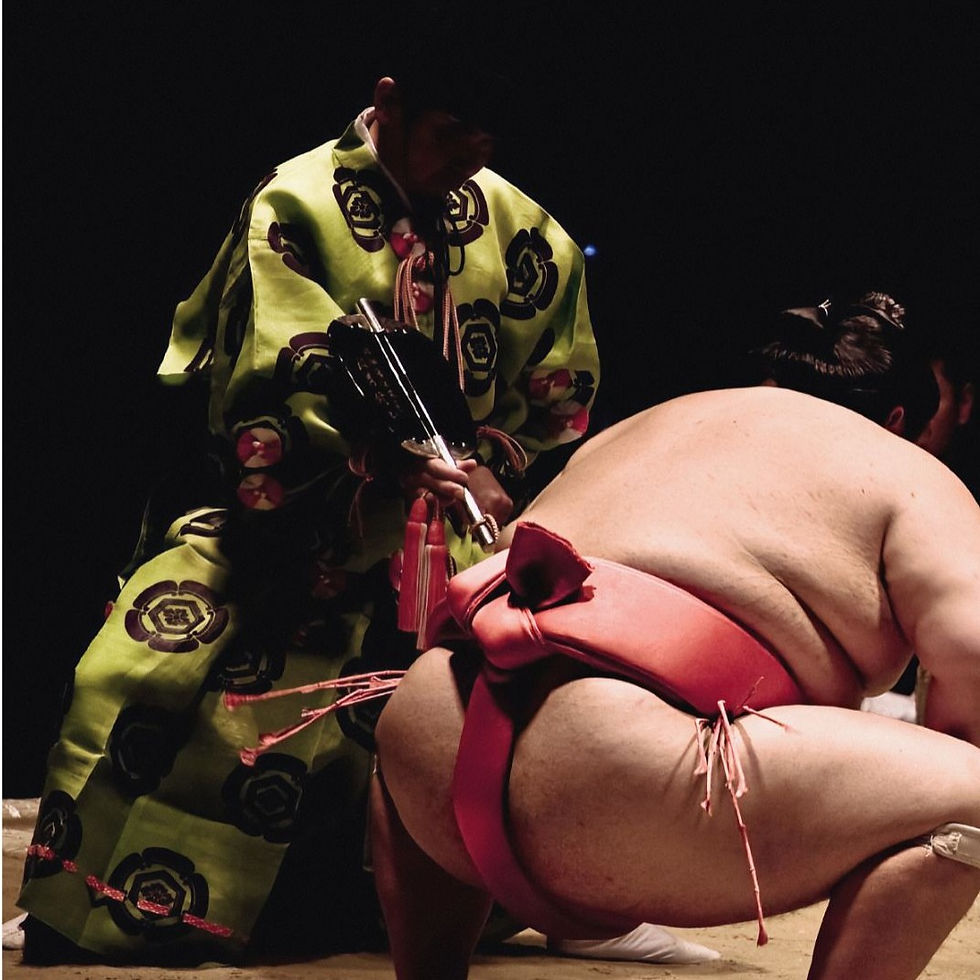
Most international first-time visitors watch the pre-bout rituals — the salt throwing, the stomping, the repeated crouching sequences — without knowing what they mean. Once you understand that the salt is purifying a sacred space, that the stomping is driving evil spirits from the earth, and that the referee carries a live blade as a declaration of personal accountability for his decisions, the ceremony transforms from an interesting delay into the heart of what sumo actually is.
For our September 16, 2026 Grand Sumo Tournament Experience, EDO KAGURA prepared a complete bout-by-bout viewing guide covering all 20 Makuuchi matchups — including each wrestler's fighting style and a specific “WATCH” point for every bout.
The matchups change every day. So does our guide.
Guests also receive a separate illustrated Sumo Culture Guide on the day of the tour, covering the rules, ranking system, tachiai, winning techniques, sacred rituals, and the 400-year history of Ryogoku.
This guide is prepared exclusively for tour participants and used during our lunchtime sumo culture briefing.
9. Warning — These Sites Are Not Official Sumo Ticket Vendors
When official channels sell out, the temptation to try resale sites is understandable. Before doing so, read this carefully.
The Japan Sumo Association explicitly warns that the following sites are not authorised vendors for the Grand Sumo Tournament:
viagogo
BuySumoTickets
StubHub
ticketstreet
ticket ryûtsû center
Yahoo Auctions and Mercari
Tickets purchased through unauthorised channels may be refused at the arena
entrance. Only tickets issued through official channels are guaranteed to be accepted.
The Japan Sumo Association has documented the following actual cases reported by affected visitors:
"The ticket I bought was fake."
"I could not receive my ticket."
"The price was more than twice the official website price."
"I purchased a Masu Box for four people and ended up sharing the box with strangers I had never met."
That last case deserves attention. Multi-person masu boxes are sold as a complete box rather than as unrelated individual seats. When unofficial resellers split a single box and sell individual places separately, the result is exactly this: strangers sitting centimetres apart for an entire afternoon, none of whom expected the arrangement. This is a documented pattern, not a hypothetical.
10. What to Do If Tickets Are Already Sold Out
If official channels are sold out and you are not prepared to accept the risks of unofficial resellers, your options are limited. The following are the realistic paths available.
Check the Official Resale Service
Ticket Oosumo operates an official face-value resale service. If a ticket holder can no longer attend, they can list an eligible ticket for resale at the original price. Buyers pay the face value of the ticket plus the applicable service fees associated with the original purchase. Resale transactions open on the Monday following the general sale date (or the next business day if Monday is a public holiday). Tickets are sold on a first-come, first-served basis, so availability depends entirely on other ticket holders listing their tickets. This is the official resale service recommended by Ticket Oosumo for people looking for tickets after a tournament has sold out. Unauthorized resale tickets, by contrast, may be refused entry.
Note: The resale service is currently available through the Japanese-language platform. A Ticket Oosumo account is required to use the service.
Plan further ahead — using the schedule in this guide
The most effective approach is to identify your target tournament well in advance and be ready to purchase the moment the official sale opens. The 2027 and 2028 sale dates in Section 2 are sourced directly from the Japan Sumo Association. Use them.
Join the official fan club before the next sale
As described in Section 5, even the most accessible paid fan club tier provides pre-sale lottery access that the general public does not have. Joining before the next tournament's sale date gives you an additional opportunity to apply before the general sale opens.
Consider a different tournament
Tokyo hosts three Grand Sumo Tournaments each year. If September is sold out, January or May offer the same arena and the same Grand Sumo Tournament format. If your Japan itinerary also takes you to Osaka, Nagoya, or Fukuoka, another tournament may be a practical alternative. See the complete 2027 and 2028 schedule in Section 2.
Do Not Rely on Same-Day Tickets
Some older English-language guides describe arriving early at Ryogoku Kokugikan and lining up for same-day tickets. That should no longer be treated as a reliable strategy.
The Japan Sumo Association's official ticket information states that tickets may be purchased on the day of the tournament if seats remain available. Online purchases through Ticket Oosumo and Ticket Pia, as well as purchases at Seven-Eleven, can continue until 17:00 on the day of attendance when tickets are still available.
However, the Japan Sumo Association also states clearly:
If tickets are sold out before the day of the tournament, there will be no same-day ticket sales.
This distinction is important. The September 2026 Tokyo Tournament sold out for all 15 days in advance, so there were no same-day tickets available at Ryogoku Kokugikan.
In other words, “same-day tickets” do not mean that a separate allocation of tickets is held back for visitors who arrive at the arena that morning. They are available only if tickets remain unsold.
If a tournament is already officially sold out, do not travel to Ryogoku Kokugikan expecting to buy a ticket at the box office. Check the Japan Sumo Association's official ticket information before you go.
Consider a guided experience that includes an official ticket
EDO KAGURA applies for official group tickets through the Japan Sumo Association's group booking channel — a route that operates separately from the public sale. When we secure tickets, guests on our Priority Waitlist are offered places before any public announcement.
Our Grand Sumo Tournament Experience includes an official tournament ticket, an authentic chankonabe lunch with a full sumo culture briefing, a two-hour guided walk through Ryogoku, Sumo Museum entry, and approximately one guide for every 5–10 guests throughout the day. The experience is open to international visitors and conducted in English, French, German, or Spanish, subject to guide availability.
If you would like to be among the first to know when our next sumo tour is confirmed, please join our Priority Waitlist. There is no obligation — waitlist guests receive advance notice before reservations open to the general public.
Watch Morning Sumo Practice
If tournament tickets are unavailable, you can still experience sumo in Tokyo. Arashio Stable allows visitors to watch morning practice for free through large street-facing windows, usually from around 7:30 to 9:00 a.m. Practice is not guaranteed, so always check the stable's official calendar before visiting.
Before You Enter the Arena — Why Understanding Sumo Changes Everything
A ticket gets you into Ryogoku Kokugikan. It does not tell you why the referee carries a sword, what the salt is purifying, why the wrestlers stomp the earth before each bout, or how to read the first second of contact that determines most bouts before the crowd has processed what happened.
We have written three guides specifically for international visitors who want to understand what they are about to watch.
→ Why Do Sumo Wrestlers Throw Salt? Understand Japanese Culture Through Sumo — The Shinto ritual, Buddhist history, and Edo culture behind sumo's most famous gesture
→ How to Watch Sumo in Tokyo Like a Japanese Fan: 10 Things That Make Every Bout More Exciting — From the referee's live blade to the grip that decides every bout
→ Things to Do in Ryogoku Before Watching Sumo: A Walking Guide for True Sumo Enthusiasts — Active sumo stables, the 47 Ronin, and the spiritual heart of sumo, all within walking distance of Ryogoku Kokugikan
Guests joining our Grand Sumo Tournament Experience receive additional bout-by-bout viewing materials designed to help them follow the day's matchups and understand what to watch for in each bout.
After our September 16, 2026 Tokyo tournament experience, one guest wrote: “It was a most entertaining, informative, and enjoyable day. Thank you for providing such an excellent experience.” They also told us they would recommend our tours to others visiting Japan.
All ticket prices and tournament information are sourced from the Japan Sumo Association's official website and price list. Dates are confirmed as of September 2026 and subject to change. Please verify current details at sumo.or.jp before making any purchase or travel arrangements.
About the Author
Shinya Yamada is the founder and CEO of EDO KAGURA, based in Kagurazaka, Tokyo. He has followed professional sumo for nearly 50 years — recording every tournament on television to ensure he never misses a bout. As a judo black belt, he understands the body mechanics that sumo and judo share at their core. He also leads EDO KAGURA's Grand Sumo Tournament experiences for international visitors, combining live tournament viewing with an introduction to sumo's history, rituals, and culture.


Comments