%20(600%20x%20120%20px)%20%E8%83%8C%E6%99%AF%E9%80%8F%E9%81%8E.png)


How to Watch Sumo in Tokyo Like a Japanese Fan: 10 Things That Make Every Bout More Exciting
Updated: 6 hours ago

The rules of sumo take about thirty seconds to explain. Two wrestlers enter a clay ring. The first to touch the ground with anything other than the soles of his feet, or to step outside the circle, loses.
That is the whole rulebook.
And yet a single bout can contain more layers of meaning — historical, spiritual, tactical, cultural — than most sports pack into an entire season. The visitors who leave Ryogoku Kokugikan most deeply satisfied are not the ones who understood the rules. They are the ones who understood the context.
This guide covers ten things that transform the experience of watching sumo in Tokyo — from the mechanics of the ranking system to the reason the referee is dressed like a medieval warrior, from the physics of the first second of contact to the word senshuraku and its unexpected roots in Noh theater.
The more you understand before entering the arena, the more exciting every bout becomes.
Table of Contents

1. Sumo Rules — The Simple Rules That Create Endless Drama
Watch Sumo in Tokyo and You Will Understand These Rules in the First Bout
The rules of sumo are among the simplest of any combat sport in the world.
A bout takes place inside the dohyo — a raised clay platform with a circular ring marked by rice-straw bales, 4.55 metres in diameter, set within a square base measuring 6.7 metres on each side. Two wrestlers, wearing only a mawashi — a thick belt of woven silk or cotton — compete to force each other out of this circle or to the ground. Victory goes to the wrestler whose opponent either steps outside the circle or touches the ground with any part of the body other than the soles of the feet.
There are no rounds, no time limits in the traditional sense, and no points. The bout ends the instant one wrestler achieves the winning condition.
The repertoire of recognised winning techniques — kimarite — numbers 82, plus five additional categories for special outcomes. The variety is genuine: sumo recognises arm throws, leg trips, body drops, twisting techniques, and even a technique in which the winning wrestler lifts his opponent entirely off the ground and carries him out of the ring.
What makes this simple framework generate endless drama is the combination of no protective equipment and the absence of any scoring system that rewards partial success. There is no equivalent of a judo waza-ari — a partial score that builds toward victory. In sumo, nothing counts until everything is decided. A wrestler who appears to be losing completely can win with a single reversal. A wrestler who dominates for thirty seconds can lose in the thirty-first.
There are no weight categories. A 90-kilogram wrestler and a 200-kilogram wrestler may face each other directly, with no adjustment for the difference. This is one of sumo's most distinctive characteristics when compared to other combat sports: judo, wrestling, and boxing all divide competitors by weight class, recognising that size creates insurmountable physical advantage. Sumo does not. The absence of weight categories is not an oversight or an anachronism — it is a deliberate expression of sumo's foundational belief that technique, positioning, and force of will can overcome physical disparity.
And the historical record confirms it. The three greatest champions in sumo history — Hakuho (45 championships), Taiho (32 championships), and Chiyonofuji (31 championships) — competed at 155, 153, and 127 kilograms respectively. All three were lighter than the current top-division average of over 160 kilograms. Chiyonofuji regularly faced opponents who outweighed him by 50 kilograms or more — and won 31 tournaments doing so.
The rules allow any size. The champions were not the biggest. That contradiction is the heart of sumo.
Sumo is also, quietly, a pioneer of technological innovation in sport.
Video review was introduced to professional sumo in May 1969 — making sumo the first professional sport in Japan to adopt video technology for officiating decisions. The catalyst was a controversial bout in the preceding March tournament between Taiho and Toda, in which a disputed result generated widespread public debate. The Japan Sumo Association's response was decisive: within months, video review was in place.
The system works as follows. When a ringside judge raises an objection to the referee's decision — a process called mono-ii — the judging panel convenes on the sand below the ring to deliberate. Video footage is available as reference material during this discussion. The final decision, however, rests with the human judges. Technology informs the judgment; it does not replace it.
This balance — ancient ritual and modern precision coexisting without contradiction — is characteristic of how sumo manages tradition. The referee still carries a blade from the medieval period. The judges still deliberate in the open, visible to the entire arena. And since 1969, they have done so with access to video evidence that most other sports would not adopt for another decade or more.
The rules are simple. Understanding why they matter is not.
2. Sumo Ranks — Why Every Match Matters More Than You Think
The ranking system — the banzuke — is the architectural frame of professional sumo. Without understanding it, you are watching individual bouts. With it, you are watching careers.
The Structure of the Banzuke
Professional wrestlers are divided into two categories: sekitori (ranked wrestlers) and development wrestlers. The gap between these two groups is the most consequential divide in professional sumo.
The top two divisions — makuuchi (42 wrestlers) and jūryō (28 wrestlers) — constitute the sekitori class. Everyone below, from makushita (120 wrestlers) through sandanme, jōnidan, and jōnokouchi, belongs to the development ranks.
Division | Rank | Number of Wrestlers |
Sekitori | ||
Makuuchi | Yokozuna | No fixed number (may be vacant) |
Ōzeki | No fixed number | |
Sekiwake | No fixed number (minimum 2) | |
Komusubi | No fixed number (minimum 2) | |
Maegashira | No fixed number | |
Jūryō | 28 | |
Development | ||
Makushita | 120 | |
Sandanme | 160 | |
Jōnidan | No fixed number | |
Jōnokuchi | No fixed number | |
Unranked | No fixed number |
Within the makuuchi division, the hierarchy runs from the bottom upward: maegashira (the rank-and-file), then the three san'yaku ranks — komusubi, sekiwake, and ōzeki — and finally yokozuna, the supreme rank, which has no fixed number of holders and may be vacant entirely.
Yokozuna promotion requires not only competitive dominance — two consecutive tournament victories as ōzeki is the standard — but also what the Yokozuna Deliberation Committee describes as hinkaku: a quality of dignity, bearing, and conduct both inside and outside the arena assessed as rigorously as the win-loss record. The rank, once granted, can never be taken away. A yokozuna who can no longer compete at the highest level is expected to retire rather than continue with declining results.
Why the Ranking System Changes Everything You Watch
Every bout in professional sumo carries ranking consequences. Wrestlers compete fifteen bouts over a fifteen-day tournament. Eight wins — a winning record — is the threshold that generally protects a wrestler's ranking or opens the possibility of promotion. Seven wins — a losing record — typically leads to demotion. However, the system is relative rather than automatic. A winning record does not guarantee promotion: a komusubi wrestler who wins eight bouts will not necessarily advance to sekiwake if all the sekiwake wrestlers also posted winning records. The rankings are recalculated after every tournament, and every wrestler's position is determined not by formula but by the judgment of the Japan Sumo Association's ranking committee, weighing results against the overall competitive landscape.
This creates a specific quality of tension that visitors who understand the system feel acutely and those who do not may entirely miss. The most dramatic bouts are often not between the highest-ranked wrestlers. They are between wrestlers whose entire immediate future depends on the next few seconds.
What Rank Unlocks
The divide between sekitori and development wrestlers is visible everywhere in the arena. Many wrestlers have said that reaching jūryō — the moment they became sekitori — was the happiest day of their professional lives. Not their first tournament victory. Not their promotion to a higher rank. The moment they crossed the threshold from development wrestler to sekitori. That single fact tells you more about the size of the divide than any list of privileges could.
Only sekitori — wrestlers of jūryō rank and above — may wear the kesho-mawashi: the ornate ceremonial apron worn during the ring-entering ceremony, made from hakata-ori or nishijin-ori silk, typically costing more than one million yen and sometimes exceeding ten million yen, with exceptional examples decorated with gold thread or precious stones. The yokozuna's set — mittsu-zoroi, comprising the yokozuna's own apron plus those of his sword-bearer and dew-sweeper attendants — commands a still higher price.
Only sekitori may wear the ōichō topknot — the ginkgo-leaf style — during tournament bouts. Wrestlers below jūryō wear the simpler chonmage.
Only sekitori may throw salt before their bouts.
Only sekitori receive a salary. Development wrestlers receive a training stipend.
When you understand these distinctions, the pre-bout ceremony transforms from ritual into biography. The kesho-mawashi a wrestler wears tells you who his sponsors are. The style of his topknot tells you his rank at a glance. The way he throws his salt tells you something about his personality and his relationship to the tradition.

3. The Sumo Tournament Schedule — Why Every Day Feels Different
Six Tournaments a Year — Where and When
Professional sumo holds six honbasho — official tournaments — each year, each lasting fifteen days. The schedule is fixed:
Month | Location | Venue |
January | Tokyo | Ryogoku Kokugikan |
March | Osaka | Edion Arena Osaka |
May | Tokyo | Ryogoku Kokugikan |
July | Nagoya | IG Arena |
September | Tokyo | Ryogoku Kokugikan |
November | Fukuoka | Fukuoka International Center |
Tokyo hosts three of the six tournaments. For visitors planning a trip specifically around sumo, the September tournament — running from September 13 to 27, 2026 — is one of three annual opportunities to watch sumo at Ryogoku Kokugikan.
Between tournaments, wrestlers participate in jūngyō — regional exhibition tours that travel through cities and towns across Japan. These are accessible and atmospheric but are distinct from the official tournaments: the ranking consequences that make honbasho so charged are absent from exhibition bouts.
Opening Day, Middle Day, and Senshuraku — Three Different Atmospheres
A fifteen-day tournament does not feel the same on every day.
Opening day — shonichi — carries the energy of new beginnings. The rankings have just been published. Wrestlers are displaying their form for the first time under tournament conditions.
By the middle of the tournament — nakabi, the eighth day — patterns have emerged. Wrestlers who are struggling are visible. Wrestlers performing above expectations have begun to attract attention. Discussions in the audience shift from general expectation to specific calculation: who is on track for promotion, who is fighting demotion, who has a chance at the championship.
The final day — senshuraku — is the most charged atmosphere in the sumo calendar. The championship is decided here. Careers are confirmed or redirected. The arena fills in a way that the middle days rarely match.
Senshuraku — A Word That Connects Sumo, Noh, and the Japanese Art of Endings
The word senshuraku does not originate in sumo. It comes from the Noh play Takasago — one of the most celebrated works in Japan's 600-year Noh theatrical tradition.
In Noh performance, the final passage of Takasago is an auspicious closing chant called senshuraku. The convention of ending a day's program with this celebratory passage — bringing positive closure to performances that might have included dramatic or unsettling scenes — gave the word its meaning: the day of final resolution, the day when everything is settled.
But the adoption of senshuraku by sumo reflects something deeper than a borrowed word. It reflects a cultural philosophy that runs through Japanese performing arts: the belief that an ending should be celebrated, not merely concluded. In Noh, the final chant restores the mood to the auspicious. In kabuki, the final scene traditionally ends on a note of resolution and beauty, however dark the drama preceding it. In sumo, senshuraku — the day when rankings are finalised, when champions are crowned, when careers are confirmed — is understood as a day of completion in the fullest sense: not a closing, but a culmination.
This shared philosophy across Japan's great performing traditions is not coincidental. Noh, kabuki, and sumo all developed within the same cultural matrix, absorbed the same aesthetic values, and understood that an audience's final experience of a performance shapes everything that came before it. The word senshuraku carries that understanding every time it is used.
Why the Referee Looks Nothing Like the Samurai You Know
Most visitors arrive with a mental image of the samurai derived from Edo-period (1603-1868) films and dramas: austere, simply dressed, functional. The Tokugawa shogunate enforced strict sumptuary laws that prohibited warriors from wearing extravagant clothing. The samurai aesthetic that dominates popular imagination is the product of those Edo restrictions.
This makes the gyoji deeply puzzling at first glance.
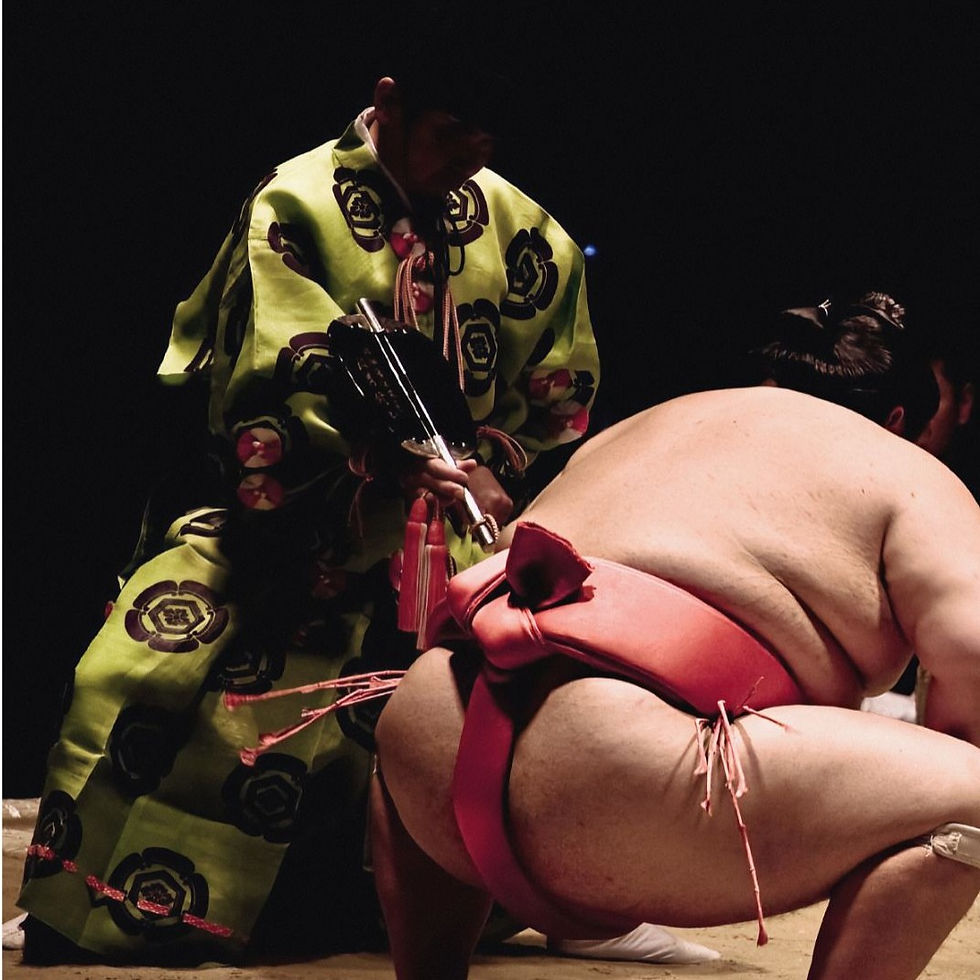
The referee wears robes of brilliant colour, layered silk, and elaborate woven patterns. He looks nothing like the Edo samurai. The reason is that his costume belongs to a different era of warrior culture entirely.
The gyoji's robe — the hitatare — is the formal ceremonial dress of a Muromachi-period (1336-1573) warrior, centuries before the Tokugawa sumptuary laws existed. In that earlier era, warriors expressed status through the beauty of their dress. Rich colours, elaborate patterns, and fine silk were marks of rank and refinement, not violations of protocol.
Oda Nobunaga, who ruled in the late Muromachi and early Azuchi-Momoyama (1573-1603) period, was devoted to both sumo and Noh — gathering wrestlers from across the country for tournaments at Azuchi Castle and performing Noh himself with unusual personal passion. It is in this period that the structural foundations of professional sumo were laid. The referee's costume — and the Noh theatrical vocabulary from which senshuraku was borrowed — are both traces of that same cultural moment.
When the Edo period arrived and the Tokugawa shogunate began regulating warrior dress, the gyoji's costume was already an established tradition. As a result, it remained largely unchanged while samurai society gradually adopted simpler and more restrained styles under the new regulations.
The gyoji therefore preserves something that has largely disappeared elsewhere: the formal attire of a Muromachi-period warrior. What many visitors assume is simply a colourful ceremonial costume is, in fact, a living reminder of an older layer of Japanese warrior culture that survived centuries of social and political change.
The result is that when you watch sumo in Tokyo today, the referee is dressed in a costume that predates the Edo period by several centuries — a more ancient layer of Japanese warrior culture preserved in plain sight.
For a deeper exploration of the connection between senshuraku and Noh theater, read our earlier article: Senshuraku: The Connection Between Noh and Sumo
Noh, kabuki, sumo — and the tea ceremony, wagashi, and kokyu. All of them emerged from the same cultural matrix. If sumo has opened a door into that world for you, EDO KAGURA's SHOGUN Experience opens three more in a single morning.
4. How Big and Strong Are Sumo Wrestlers? Why Size Is Only Part of the Story
The Numbers
There are no weight categories in professional sumo. A wrestler who weighs 100 kilograms and a wrestler who weighs 200 kilograms compete under identical conditions.
The heaviest wrestlers in the top division have historically exceeded 280 kilograms. A typical upper-division wrestler weighs between 140 and 180 kilograms. But the division also includes wrestlers who compete effectively at 110 or 120 kilograms — lighter than many recreational athletes in other contact sports.
To become a professional wrestler, a candidate must pass a medical examination and a physical aptitude test administered by the Japan Sumo Association. The age limit remains 23 for most applicants, extended to 25 for those with strong amateur competitive records. Until 2023, minimum height and weight requirements applied — 167 centimetres and 67 kilograms for general applicants. Following a revision to the regulations in September 2023, however, these physical standards were effectively abolished. A candidate who does not meet the traditional height and weight criteria may now qualify through a secondary athletic ability examination. The door to professional sumo is, in principle, open to anyone who can demonstrate the physical capability to compete.
Why the Heaviest Wrestler Does Not Always Win
The absence of weight categories reflects a fundamental principle of sumo: the contest is decided by technique, positioning, and will, not by physical advantage alone.
The technique hatakikomi — a slap-down that redirects an advancing opponent's force — is specifically designed to neutralise size advantage and ranks among the more frequently occurring winning techniques. A lighter, faster wrestler who achieves superior positioning in the tachiai may win before the heavier wrestler's size advantage becomes relevant.
What Sumo Wrestlers Actually Train
The lower body development required for competitive sumo — hip flexors, inner thigh muscles, gluteus, core — is achieved primarily through shiko (the stomping exercise), suri-ashi (sliding-step drills), and butsukari-geiko (full-force collision practice). A wrestler's hip flexibility is often more diagnostically important than his weight: the ability to maintain a low centre of gravity, absorb impact with bent knees, and recover from off-balance positions depends entirely on flexibility and lower-body strength.
Grip strength is exceptional across the division. The mawashi is the primary target in most grappling exchanges, and the ability to secure and maintain a dominant grip on 10 metres of tightly wound silk, against an opponent trying to break it, requires sustained forearm and hand strength that most strength sports do not develop.

5. Judo, Wrestling, and Sumo — What to Notice While Watching
Many professional sumo wrestlers come from judo or wrestling backgrounds. Judo in particular, as a fellow Japanese martial art, is frequently compared to sumo — and for good reason. Both disciplines share the same foundational emphasis on grip, body positioning, and the decisive importance of the moment of first contact.
The similarities between Sumo and Judo are not coincidental. Jigoro Kano, the founder of judo, studied sumo extensively as part of his research into Japanese martial traditions while developing judo's principles in the 1880s. The throwing techniques, the emphasis on off-balancing an opponent before applying force, and the concept of using an opponent's movement against him all reflect sumo's influence on Kano's thinking. (Source: Draeger and Smith, Asian Fighting Arts, 1969)
The migration runs in the other direction as well. Baruto — the Estonian-born ōzeki — was a national judo champion in Estonia before his sumo career. The current yokozuna Hoshoryu was exposed to judo from an early age before finding sumo. Athletes who develop grappling instincts in judo find that sumo's core demands translate directly.
Mongolian bökhö — traditional Mongolian wrestling — shares with sumo an emphasis on grip, body positioning, and the decisive importance of first contact. The transition from bökhö to sumo explains much of the success of Mongolian wrestlers at the highest levels of professional sumo over the past two decades.
The Concept of Grip — What to Watch
In both judo and sumo, the contest is decided by grip.
In judo, the moment two players establish their hold on each other's judogi, the competitive dynamic is set. A judoka who secures a dominant grip in the first second of contact has, in the most meaningful sense, already won.
Sumo operates on precisely the same principle. The mawashi is not simply a costume. It is the primary competitive instrument of the sport. A wrestler who secures the grip he wants — uwate (outside grip) or shitate (inside grip) on the belt — has established the positional foundation from which most bouts are resolved.
This is why the tachiai — the explosive initial charge — is the most important moment in the match. The salt, the shiko, the repeated shikiri preparations: all of it is calibration toward a single instant.
What to Notice in the First Second
When watching sumo in Tokyo, the moment to watch most carefully is the moment of first contact.
Where do the hands land? Has one wrestler established contact with the opponent's belt, or has he been deflected to the chest or arms? Has one wrestler achieved a lower position, bending his knees to bring his centre of gravity below the opponent's?
Reversals do happen. But the rule, across sumo, judo, wrestling, and bökhö, is that position established at first contact tends to determine the outcome.
Before each bout in our experience, I share what I am watching for — the hand position, the direction of the first drive, which wrestler is likely to secure the grip he wants. Then we watch together. The bout almost always develops exactly as the opening moment suggested.

6. Winning Techniques — The Moves That Decide Most Bouts
The 82 Techniques — and Why Most of Them Are Rare
Professional sumo recognises 82 winning techniques (kimarite), plus five additional outcome categories for special situations. The full list ranges from the most basic push-out to techniques so rare they may appear only a handful of times per year across the entire division.
The Data That Changes How You Watch
The following table is based on 188,205 bouts recorded between January 2013 and the May 2026 tournament, sourced from the Japan Sumo Association's official kimarite records as provided in this article's research materials.
Rank | Technique | Type | % |
1 | Oshi-dashi (push-out) | Basic | 25.18% |
2 | Yori-kiri (force-out) | Basic | 24.92% |
3 | Hataki-komi (slap-down) | Special | 8.24% |
4 | Tsuki-otoshi (thrust-down) | Twist | 5.43% |
5 | Yori-taoshi (force-down) | Basic | 4.81% |
6 | Uwate-nage (overarm throw) | Throw | 4.62% |
7 | Hiki-otoshi (pull-down) | Special | 3.47% |
8 | Oshi-taoshi (push-down) | Basic | 3.44% |
9 | Okuri-dashi (rear push-out) | Special | 3.29% |
10 | Shitate-nage (underarm throw) | Throw | 2.27% |
The two most basic techniques — push-out and force-out — account for 50.1% of all bouts.
What This Means When You Are Watching
Oshi-dashi and yori-kiri are techniques of positional dominance. They do not require the complex set-up that a throw demands. They require a wrestler to establish superior position at the moment of first contact and to maintain and extend that advantage until the opponent crosses the boundary.
The throw techniques — uwate-nage, shitate-nage — appear when positional equilibrium is closer, or when a wrestler deliberately sacrifices positional safety to attempt a high-risk reversal. These are the most visually dramatic moments in sumo, and they occur precisely because the more fundamental contest of positioning has not produced a clear winner.
Hataki-komi — the slap-down — works when an advancing wrestler overcommits his forward momentum, allowing his opponent to deflect his charge and use his own force against him. It is the technique most associated with size reversal.
When watching sumo in Tokyo, the critical moment to observe is the instant of the tachiai — specifically, the position of the hands and feet at first contact.
Are the hands reaching for the mawashi, or driving into the opponent's chest to prevent a grip? Which wrestler has secured the more advantageous position? The answer depends on each wrestler's preferred style. A wrestler who specialises in yotsu-zumo — grappling sumo built around belt grips — is in a strong position the moment he establishes his preferred hold. A wrestler who specialises in oshi-zumo — pushing sumo — is in a strong position when he has denied his opponent any grip on the belt and is driving forward with open-handed thrusts. The tachiai is where these competing strategies collide, and reading which wrestler has achieved his preferred position in that instant is the single most important thing to watch.
Predicting the outcome with certainty is not possible. But the fact that there is a readable structure — that the first positions tell a story — is precisely what makes each subsequent second more meaningful. You are not simply watching. You are following a logic that is unfolding in real time.

7. Sacred Rituals — Why Sumo Is More Than a Sport
Many Visitors See a Sport. Japanese Fans Often See a Ritual.
The pre-bout ceremony that precedes each top-division match is not a delay. It is the bout's spiritual preparation, and it predates the competitive rules by centuries.
Sumo's origins, as recorded in both the Kojiki (712 AD) and the Nihon Shoki (720 AD), are not athletic. The earliest records describe sumo as a ritual performed to determine the agricultural harvest — a sacred contest in which the outcome was understood as a message from the gods about the year's crops. This practice became a formal court ceremony and continued for three centuries.
The Dohyo-Matsuri — Why the Ring Is Sacred Before Anyone Steps Into It
The sacred character of the dohyo does not begin with the wrestlers. It begins the day before the tournament opens, with a ceremony called the dohyo-matsuri.
Presided over by the senior referee in the role of chief Shinto priest, the dohyo-matsuri consecrates the ring for the fifteen days of competition ahead. Into the centre of the ring, offerings are buried: rice, salt, dried cuttlefish, dried chestnuts, kombu seaweed, and sake. These are the same categories of offering made at Shinto ground-breaking ceremonies throughout Japan — gifts to the spirits of the earth, acknowledgments that the space is sacred, and requests for the protection of those who will compete on it.
The gods are formally invited into the ring before the first bout of the tournament. They are formally sent away at the close of the final day. The dohyo is not a permanent sacred space. It is consecrated for the tournament and then returned. This is why the salt, the shiko, and the other purification rituals matter: they maintain the sacred condition of a space that has been formally dedicated to the divine.
The Sacred Elements — What to Watch For
Salt (shio): The coarse sea salt thrown across the ring purifies the sacred space of the dohyo. Only sekitori may throw salt. Approximately 45 kilograms is used at Ryogoku Kokugikan on a single day of tournament sumo.
Stomping (shiko): Raising one leg high and driving the foot into the earth drives evil spirits from the ground beneath the ring and summons the protection of the gods below, addressing the four cardinal directions in sequence.
Showing empty hands (chiri-chozu): The gesture in which each wrestler extends both arms with palms turned upward demonstrates to the gods and his opponent that he carries no weapons — the oldest declaration of honourable intent in Japanese martial tradition.
The yokozuna's rope (tsuna): The thick white rope worn only by a yokozuna is a shimenawa — the sacred rope that marks the boundary between the sacred and the ordinary world at Shinto shrines across Japan. Made from hemp, weighing between five and twenty kilograms, it is hand-braided by members of the wrestler's own stable. The right to wear it was historically granted by the Yoshida Tsukasa family, a lineage governing sumo's ceremonial traditions for more than 800 years.
The referee's blade (kaiken): The short blade carried at the hip of the most senior referees is a live blade — 22 centimetres in length — held under formal permission from the Tokyo Metropolitan Public Safety Commission under Japan's Firearms and Swords Control Law. It represents the referee's declaration that he bears ultimate personal responsibility for his judgments. Should he make a serious error, he is expected to submit a formal letter of resignation to the Japan Sumo Association. The blade is the material form of that accountability.
For a full exploration of sumo's Shinto and Buddhist spiritual history — including the 75-year sumo sanctuary at a Buddhist temple in Ryogoku — read: Why Do Sumo Wrestlers Throw Salt? Understand Japanese Culture Through Sumo

8. Foreign Wrestlers — How an Ancient Japanese Tradition Became Global
The First Wave: Hawaii
Professional sumo remained exclusively Japanese in its upper divisions until 1972, when Takamiyama — born Jesse James Wailani Kuhaulua in Hawaii — became the first foreign-born wrestler to win a top-division tournament. His success demonstrated that the physical and technical demands of professional sumo could be met by athletes from outside Japan.
The Hawaiian wave that followed produced two yokozuna: Akebono (the first foreign-born yokozuna, promoted in 1993) and Musashimaru. A third Hawaiian wrestler, Konishiki, won three championships but was controversially passed over for yokozuna promotion despite a competitive record that many observers considered sufficient. His case remains one of the most debated decisions in modern sumo history.
The European Contribution
The late 1990s and 2000s brought European wrestlers whose backgrounds in judo, sambo, and freestyle wrestling gave them technical foundations that transferred effectively to sumo's demands.
Baruto, from Estonia, was a national judo champion before his sumo career and reached ōzeki — the second-highest rank. Kotoōshū, from Bulgaria, brought a wrestling background that made him one of the most technically refined wrestlers of his generation. Both exemplified the principle that sumo's competitive core — grip, positioning, body control — is accessible to athletes who have developed equivalent skills in other grappling traditions.
The Mongolian Transformation
The most significant change in professional sumo's recent history is the sustained dominance of Mongolian wrestlers, which began in the late 1990s and has continued without interruption.
Mongolian wrestlers arrive with backgrounds in bökhö — traditional Mongolian wrestling — which shares with sumo an emphasis on grip, body positioning, and the decisive importance of first contact. Of the six wrestlers to have held the yokozuna rank since 2000, five have been Mongolian. Hakuho — who held the rank from 2007 to 2021 — won 45 tournament championships, a record unlikely to be approached in the near future. The current yokozuna, Hoshoryu, continues this presence at the summit of the sport.
The debate this dominance has generated — about nationality, cultural ownership, and what it means for a Japanese cultural institution to be led by non-Japanese practitioners — is one of the most substantive ongoing discussions in Japanese sports. Watching sumo in Tokyo today means watching a sport that is simultaneously an ancient Japanese cultural tradition and a genuinely international competitive arena.
9. Chanko Nabe — The Meal That Built Sumo
The Meal Every Sumo Wrestler Lives On
Chankonabe — the hot pot dish that is the staple food of sumo wrestlers — is one of the most recognisable elements of sumo culture outside the arena. Visitors to the Ryogoku district of Tokyo will find chankonabe restaurants on almost every street, many operated by retired wrestlers or their stables.
The dish is a substantial hot pot: a protein-rich broth containing vegetables, tofu, and meat, served with rice and eaten in quantities calibrated to a wrestler's size and training schedule. The combination of high protein, high carbohydrate, and high caloric density supports the body composition that professional sumo demands.
Why Sumo Wrestlers Traditionally Eat Chicken
The most interesting aspect of chankonabe is not its nutritional profile but its cultural logic.
The dish traditionally centres on chicken rather than beef, pork, or other four-legged animals. According to a popular sumo tradition, the reason is directly connected to sumo's competitive rules.
In sumo, a wrestler loses the moment any part of his body other than the soles of his feet touches the ground. Four-legged animals — cows, pigs, horses — move on all four limbs. By the logic of sumo culture, an animal that regularly makes contact with the ground on four points is not an auspicious dietary choice for a wrestler whose entire competitive life depends on never doing so.
The chicken, by contrast, stands and moves on two legs. It walks upright. It does not touch the ground with its wings unless in distress. Eating an animal that shares the two-footed stance of a wrestler in good standing is, by this tradition, considered appropriate — even propitious.
This reasoning reflects the extent to which sumo's rules and values permeate every aspect of a wrestler's life, including what he eats for lunch.
After watching sumo in Tokyo, eating chankonabe in Ryogoku is one of the most recommended ways to continue the experience. Many restaurants in the neighbourhood are operated by former wrestlers or their stables, and the connection to the sport is genuine.
The same logic extends to another Kokugikan tradition that surprises many visitors. The arena's basement kitchen produces yakitori — grilled chicken skewers — that have become one of the most talked-about food experiences in Tokyo sumo culture. During each fifteen-day tournament, the underground kitchen operates from five in the morning, producing an average of 50,000 skewers per tournament. The yakitori is available inside the arena during tournaments and at selected outlets around Tokyo year-round, but the experience of eating it fresh at the Kokugikan — five skewers in a small box for 750 yen, the flavour described by devoted fans as unlike any other yakitori in the city — belongs to the tournament itself.
During the tournament, the Kokugikan's basement also houses a large dining hall that operates only during the fifteen days of each honbasho. Each day features a different stable's chankonabe recipe — the genuine article, prepared according to the traditions of active sumo stables — served at approximately 500 yen per bowl. For visitors who want to experience chankonabe not as a restaurant interpretation but as the actual meal that professional wrestlers eat, this is the place to do it.

10. Women and the Dohyo — One of Sumo's Most Debated Traditions
The Rule and Its History
The dohyo is formally restricted to male participants under the current rules of the Japan Sumo Association. Women may not enter the ring, either as competitors or in any ceremonial capacity. This prohibition has generated substantial public debate, particularly when elected officials who are women have been asked to step away from the ring during award ceremonies or medical emergencies.
The historical origins of this rule are more complex than the current policy might suggest.
Professional sumo's claim to sacred tradition — and the associated argument that the dohyo's prohibition on women derives from ancient Shinto practice — became the official justification for the rule when sumo was formalised as Japan's national sport during the Meiji period. The formalisation came with a deliberate emphasis on sumo's Shinto connections and its status as a uniquely dignified national institution.
However, the historical record is more ambiguous. Until the early Meiji period, female sumo — onna-zumo — was performed as a popular entertainment in various parts of Japan, drawing crowds in Edo and Osaka. An important distinction applies here: professional sumo and entertainment-style female sumo were historically different traditions, developed separately and understood by their audiences as distinct. The existence of onna-zumo as popular entertainment did not challenge the status of professional sumo as a male institution. They occupied different cultural spaces.
The prohibition on women in the dohyo that is now presented as an ancient and unbroken tradition was, in historical fact, consolidated as part of Meiji-era reform rather than inherited unchanged from antiquity.
Interestingly, while the legendary origins of sumo are usually traced to the contest between Nomi no Sukune and Taima no Kehaya, the first recorded use of the word "sumo" in the Nihon Shoki appears in a description of court women competing in strength contests.
The Current Debate
The Japan Sumo Association's current position is that the prohibition reflects the sacred character of the dohyo as a Shinto ritual space, and that the tradition should be preserved. Critics argue that the sacredness of the dohyo was retroactively emphasised during the Meiji period, and that the current rule reflects that historical construction rather than an unbroken ancient practice.
This is not a question with a simple answer, and this article does not attempt to provide one. It is, however, a question worth knowing about when watching sumo in Tokyo — because understanding the historical complexity makes the tradition more interesting, not less.
The more layered and contested a tradition, the more it reveals about the culture that sustains it.

Watch Sumo in Tokyo Like a Japanese Fan — And Experience the Difference
To understand sumo is not simply to understand a sport. It is to understand how Japan sees hierarchy, ritual, discipline, beauty, and community.
In a single afternoon at Ryogoku Kokugikan, you encounter hierarchy made visible in the size of a wrestler's name on a hand-calligraphed ranking sheet. You encounter ritual in the salt, the stomping, and the sacred rope that only the highest-ranked wrestler may wear. You encounter aesthetic sensibility in the referee's six-century-old costume and the thousand-year-old word used to describe the final day. You encounter history in the foreign wrestlers who have transformed an ancient Japanese institution while competing under its rules. And you encounter the physical intelligence of a sport in which the decisive moment lasts less than one second and is decided by principles that connect sumo to judo, wrestling, and Mongolian bökhö — a universal grammar of grappling that crosses every cultural boundary.
Hierarchy, ritual, respect, community, discipline, aesthetics, religion, and competition: all of it exists in a single arena, in a single afternoon.
Most visitors to Ryogoku Kokugikan arrive with tickets.
Very few arrive with understanding.
The difference between those two groups is the difference between seeing sumo and truly understanding what you are watching — and it is only through understanding that the experience becomes what it was always capable of being.
Not sure how to get tickets? Read our complete guide: How to Get Sumo Tickets in Tokyo 2027
Want to experience a Grand Sumo Tournament with us? We hope to offer similar tours in 2027. → Join the Priority Waitlist for 2027 Tours
Ready to go deeper on the rituals? → Why Do Sumo Wrestlers Throw Salt? Understand Japanese Culture Through Sumo
The connection between sumo's final day and Noh theater: → Senshuraku: The Connection Between Noh and Sumo
Planning to visit Ryogoku before the tournament? → Things to Do in Ryogoku Before Watching Sumo: A Walking Guide for True Sumo Enthusiasts
Tournament statistics are sourced from the Japan Sumo Association's official kimarite records for the period January 2013 through May 2026, as provided in this article's primary research materials. Historical claims regarding senshuraku, the gyoji costume, and the history of female sumo reflect publicly available scholarly and institutional sources including the Japan Sumo Association's official publications. The chankonabe cultural tradition regarding chicken is a popular sumo tradition and should be understood as such. Information on tournament schedules and rankings is subject to change; please confirm current details at sumo.or.jp before making any arrangements.
The Same Edo World — A Different Morning
Sumo is not the only living tradition from this world. Sumo is not the only living tradition from this world. Kagurazaka, eleven minutes away by train, offers more.
The same period that produced professional sumo also produced wagashi confectionery, the tea ceremony, and the kokyu — a bowed string instrument whose sound defined the atmosphere of Edo's entertainment districts. These are not separate traditions. They are different expressions of the same cultural moment.
EDO KAGURA's SHOGUN Cultural Experience brings these expressions together in a single morning in Kagurazaka, Tokyo.
Kagurazaka walking tour: a guided walk through one of Tokyo's last surviving geisha districts — the neighbourhood that has preserved Edo's living traditions more completely than almost anywhere else in the city
Wagashi: crafted by a master certified by the Tokyo Metropolitan Government as a meister and supplier to the Imperial Household
Tea ceremony: the ritual of ma — interval and silence — that underlies every Japanese performing art
Kokyu: performed by Daisuke Kiba, who contributed to the Emmy Award-winning SHOGUN soundtrack and has performed with Grammy winner Alicia Keys


Comments