%20(600%20x%20120%20px)%20%E8%83%8C%E6%99%AF%E9%80%8F%E9%81%8E.png)


Tokyo Wagashi: From Imperial Kyoto to the Shoguns of Edo
Updated: Aug 17

Tokyo is one of the best places in Japan to discover wagashi, or traditional Japanese sweets. But to understand Tokyo wagashi, we first need to look back to Kyoto and Nara.
Long before Edo, the city that would later become Tokyo, emerged as Japan's political center, sophisticated confectionery traditions had developed around the Imperial Court, temples, the warrior elite, and later the culture of tea. These traditions eventually traveled east, where they entered a very different world.
Edo was a rapidly growing city of shoguns, daimyo, merchants, craftsmen, temples, and townspeople. As sugar became more widely available, confectionery culture expanded far beyond elite circles. Refined sweets for powerful families existed alongside new treats enjoyed by ordinary people.
That transformation helps explain why Tokyo's wagashi culture is so diverse today.
This is the story of how Japanese sweets traveled from the old capitals to Edo, how the Tokugawa shoguns helped reshape their history, and how that tradition continues in places such as Kagurazaka today.
Table of Contents
What Is Tokyo Wagashi?
Wagashi are traditional Japanese sweets. The word combines wa, meaning Japanese, and kashi, meaning sweets or confectionery.
There is no single officially defined category called "Tokyo wagashi." In this guide, we use the term to describe the confectionery traditions that developed in Edo and continue in modern Tokyo.
That distinction matters.
Tokyo wagashi is not simply a collection of beautifully shaped nerikiri. Its history includes elegant sweets prepared for shoguns and daimyo, offerings for temples, seasonal confectionery, and popular sweets enjoyed by the residents of one of the world's great early-modern cities.
By the late Edo period (1603-1867), Tokyo's predecessor had developed an extraordinarily varied confectionery culture, including daifuku, sakura mochi, kashiwa mochi, imagawayaki, suama, okoshi, senbei, yokan, kintsuba, and other sweets.
But that story did not begin in Edo.

Tokyo Wagashi vs. Kyoto Wagashi: How Are They Different?
It is tempting to describe Tokyo and Kyoto wagashi as two completely separate traditions. Their histories are much more closely connected than that.
Kyoto had already been a center of political, religious, and artistic culture for centuries before Edo became the seat of the Tokugawa shogunate. Confectionery developed in close relationship with the Imperial Court, temples, and eventually the tea ceremony.
By the Heian period(794-1185), sweets were already being presented to the Imperial Court. Over later centuries, the development of tea culture helped transform Japanese confectionery into something increasingly delicate, seasonal, and aesthetically sophisticated.
The tea ceremony was particularly important. Tea gatherings became spaces not only for drinking tea, but also for cultural exchange among warriors and elites. The development of wabi-cha, eventually perfected by Sen no Rikyu, emphasized simplicity, restraint, seasonality, and careful attention to detail.
Wagashi evolved alongside that culture.
The refined designs associated with wagashi today were therefore not created in isolation. They emerged through centuries of interaction between confectionery, tea, poetry, nature, craftsmanship, and the aesthetic traditions centered largely in Kyoto.
Edo inherited many of these traditions, but transformed them inside a very different social environment.
The new city had the Tokugawa shogunate and daimyo households at the top, but it was also populated by vast numbers of merchants, artisans, and townspeople. Demand existed for both expensive formal confectionery and more accessible everyday sweets.
So rather than thinking simply:
Kyoto wagashi vs. Tokyo wagashi
it may be more useful to think:
Kyoto and Nara provided important cultural roots; Edo adapted those traditions to a new urban society.
That is where the distinctive story of Tokyo wagashi begins.

How Kyoto and Nara's Confectionery Traditions Came to Edo
Few confectioners illustrate this movement better than Shiose Sohonke.
The history of Shiose dates back to 1349, more than 250 years before the beginning of the Edo period (1603-1867).
Its origins are associated with Rin Jōin, who came from China and settled in Nara, where he is traditionally credited with making manju filled with sweet bean paste. Later generations developed the family confectionery tradition in Nara and Kyoto.
By the 15th century, the Kyoto branch had established relationships with the highest levels of Japanese society.
The family received permission to use the imperial five-and-seven paulownia crest, while Ashikaga Yoshimasa, the eighth shogun of the Muromachi shogunate, is recorded as having bestowed a sign upon the confectioner.
After the disruption of the Ōnin War, the family returned to Kyoto and operated in an area that became known as Manjuyacho — literally, "manju makers' town."
Then the political center of Japan shifted east.
Following the rise of Tokugawa Ieyasu and the establishment of the Tokugawa shogunate, Shiose's confectionery tradition also became firmly established in Edo. By the 17th century, Shiose was operating in the city and supplying Edo Castle.
This makes Shiose an extraordinary example of cultural transmission.
A confectionery tradition cultivated first in Nara and Kyoto did not disappear when political power moved east.
It moved with it.
But once transplanted into Edo, it entered a very different cultural ecosystem.

The Shogun's Sweet: Tokugawa Ieyasu, Kabuto Manju, and Zojoji Temple
One of the most memorable stories connecting wagashi with the Tokugawa shogunate concerns Tokugawa Ieyasu.
According to a historical tradition recorded by Shiose Sohonke, Ieyasu placed Shiose's hon-manju on his helmet and offered it before the Kuro-Honzon, a Buddhist image associated with his military victories, while praying for success in battle.
The sweet came to be known as Kabuto Manju — "helmet manju."
The Kuro-Honzon was closely associated with Ieyasu and was later enshrined at Zojoji Temple, the Tokugawa family's major temple in Edo.
Shiose also records that it supplied large manju as offerings to the Kuro-Honzon under orders from the shogunate.
These offerings helped establish a broader association between manju and Buddhist temple rituals in Edo.
Whether encountered as food, gift, offering, or symbol, wagashi could therefore occupy a place far beyond dessert.
It could connect political authority, religion, ritual, and confectionery craftsmanship.
That is an important part of the Tokyo wagashi story: sweets existed both in the everyday world of the city and in the ceremonial world of the shogunate.

How Sugar Changed Wagashi in the Edo Period
Wagashi could not have spread widely without another crucial ingredient: sugar. For centuries, sugar was scarce and expensive in Japan. A major turning point came during the Edo period.
The eighth Tokugawa shogun, Tokugawa Yoshimune, promoted domestic sugar production. As Japan's ability to produce sugar increased, it became progressively easier to use larger quantities of sugar in confectionery.
This had a major effect on the development of wagashi. Sophisticated sweets using sugar developed particularly around Kyoto, while distinctive confectionery cultures gradually spread to other parts of Japan.
Tea culture had already helped transform Japanese confectionery aesthetically. Wider access to sugar now made it possible for the culture of sweets to expand much further.
The story was therefore not simply:
sugar became available → wagashi appeared.
Rather, several forces came together:
centuries of confectionery technique
tea culture and aesthetics
greater access to sugar
the enormous consumer market of Edo
Together, they created the conditions for an extraordinary expansion of wagashi culture.

How Edo Transformed Wagashi into an Urban Culture
By the 19th century, Edo had grown into a metropolis of more than one million people.
Its waterways, markets, shops, restaurants, craftsmen, merchants, temples, samurai residences, and entertainment districts supported one of the most sophisticated urban food cultures of the early modern world.
Wagashi became part of that transformation.
At one end of the market were prestigious confectioners such as Shiose, supplying daimyo households, temples, and elite customers.
Historical order records preserved by Shiose include sweets purchased by daimyo families for New Year celebrations, Buddhist memorial services, and other formal occasions.
At the other end was a rapidly expanding popular market. As sugar became easier to obtain and Edo's food culture developed, confectioners produced a remarkable variety of sweets.
These included familiar examples such as:
daifuku
sakura mochi
kashiwa mochi
imagawayaki
suama
okoshi
senbei
kintsuba
various forms of yokan
alongside much more elaborate confectionery intended for ceremonial and elite occasions.
This is one reason Tokyo wagashi should not be reduced to a single aesthetic.
Edo supported both refinement and accessibility.
A highly sophisticated confection created for a daimyo household and an inexpensive sweet purchased by an ordinary townsman belonged to very different worlds of consumption.
Yet both were part of the same rapidly expanding urban confectionery culture.
Highly refined visual design was flourishing as well.
Shiose preserves Edo-period confectionery sample books showing colorful and intricate sweets — essentially illustrated catalogs demonstrating what craftsmen were capable of creating.
Wagashi was increasingly something to enjoy with the eyes as well as the palate.

Wagashi Was Already an Edo Attraction Over 300 Years Ago
Today, travelers might type "Tokyo wagashi" into Google to decide which sweets to try during their visit.
People in Edo had their own version of the same behavior. Guidebooks and commercial directories introduced famous shops, restaurants, products, and specialty foods throughout the city.
Shiose repeatedly appeared in Edo publications such as Murasaki no Hitomoto, Edo Zukan, Zoku Edo Sunago, Edo Meibutsu Saiken, and Edo Kaimono Hitori Annai.
In Murasaki no Hitomoto, descriptions of Edo specialties dating back to the 17th century already included Shiose's manju alongside rice sweets, okoshi, senbei, candies, and other famous foods.
Later guidebooks continued to treat Shiose manju as one of Edo's celebrated specialties. In other words, looking for famous sweets while exploring Tokyo is hardly a modern tourist habit.
People were consulting guidebooks to discover celebrated confectionery in Edo more than 300 years ago.
The technology has changed.
The impulse has not.
Today's visitors searching for Tokyo wagashi are continuing a surprisingly old tradition: discovering the city through its sweets.
Today, tasting wagashi in neighborhoods such as Kagurazaka, Nihonbashi, Asakusa, and Ryogoku is more than simply enjoying something sweet. It can also be a way to trace Tokyo's history and culture through confectionery, much as people in Edo discovered the city through its famous sweets more than 300 years ago.

Tokyo Wagashi Is More Than Nerikiri
For many international visitors, the first image associated with wagashi is a beautifully sculpted piece of nerikiri. That makes sense.
Nerikiri is a refined type of wagashi made by kneading white bean paste (shiro-an) with gyuhi, a soft, chewy confection made from glutinous rice flour. Its pliable texture allows skilled artisans to shape delicate seasonal motifs, making nerikiri one of the most visually striking forms of wagashi. It is also closely associated with Japanese tea culture.
But wagashi is much broader. Edo's confectionery history included everything from sophisticated ceremonial sweets to foods that became part of everyday urban life.
Sakura mochi, daifuku, kintsuba, yokan, senbei, and many other sweets tell a different side of the story from highly decorated jo-namagashi.
Even within one city, wagashi can vary enormously in texture, ingredients, purpose, appearance, and price.
Some are shaped to evoke a fleeting moment in nature.
Some are prepared for festivals or religious observances.
Some are formal gifts.
Others are simply something delicious to enjoy with tea.
This diversity is itself one of the pleasures of discovering wagashi in Tokyo.

Why Seasons Matter in Tokyo Wagashi
Another defining characteristic of wagashi is its relationship with Japan's seasons.
Colors, shapes, ingredients, and names can change throughout the year.
Plum blossoms, cherry blossoms, fresh green leaves, flowing water, autumn foliage, chrysanthemums, and snow may all become inspiration for a sweet.
Japanese confectioners do not necessarily reproduce nature literally. Instead, a flower, leaf, stream, moon, or seasonal scene may be simplified into a few carefully chosen colors, forms, and textures.
This is particularly visible in jo-namagashi, where a confectioner can transform bean paste into an impression of the season small enough to fit in the palm of your hand.
For travelers who want to explore this relationship more deeply, our separate guide to Wagashi and Tea Ceremony explains how wagashi, matcha, tea-room aesthetics, Zen, and Japanese seasonality are interconnected.
Baika-tei: A Tokyo Wagashi Story of Survival and Renewal
The history of Tokyo wagashi did not end with the Edo period. One modern example can be found at Kagurazaka Baika-tei.
Baika-tei was founded independently in 1935 by Matsuzo Inoue, who came to Tokyo from Niigata and trained as a confectioner before receiving permission to establish his own shop through Baika-tei in Yanagibashi. After beginning his business in the Yodobashi area, his life was disrupted by war. He was called into military service and, after Japan's surrender, detained in Siberia.
During his internment, Matsuzo often remembered the kakimochi his mother had made in Niigata. He hoped that, if he returned home alive, he could create a wagashi recalling that flavor. After surviving and returning to Japan, that memory eventually inspired Ayu Tempura Monaka — a fried monaka shaped like an ayu, or sweetfish, recalling the Uono River of his hometown.
After the war, Baika-tei rebuilt its business in Tokyo, operating for decades in Ikebukuro while also establishing stores in Yurakucho and Kagurazaka. The family eventually chose Kagurazaka as its permanent home.
Baika-tei's story reflects something larger about Tokyo wagashi: tradition is not simply preserved unchanged. It survives through migration, war, rebuilding, memory, and adaptation.

Kagurazaka Baika-tei: Where Tokyo Wagashi Lives Today
Baika-tei's eventual choice of Kagurazaka is fitting. During the Edo period, the area was closely connected with samurai residences near Edo Castle, and in the Meiji and Taisho periods it developed into one of Tokyo's important entertainment districts, with restaurants, theaters, and a flourishing geisha community.
Today, Kagurazaka still retains narrow alleys, temples, traditional restaurants, and traces of its historic geisha district alongside modern Tokyo life. It is an appropriate setting for a confectioner carrying Tokyo's wagashi tradition into the present.
Baika-tei follows the principle of preparing bean paste specifically for each wagashi. Rather than relying on one standard filling, the shop makes around 23 different types of anko, adjusting sweetness, softness, and texture to suit each confection.
That craftsmanship is represented today by Takeshi Inoue, who holds the titles of Tokyo Meister and Excellent Wagashi Artisan. According to the latest published list from the Japan Wagashi Association, 160 artisans in Japan have been certified as Excellent Wagashi Artisans, and Inoue is among them. He is also featured on an English-language wagashi website operated with the cooperation and supervision of the Japan Wagashi Association.
At Baika-tei, tradition is not static. According to Inoue, the shop creates at least 16 varieties of jo-namagashi each month, changing the designs roughly every two weeks. Including special orders for tea gatherings and other occasions, around 200 different jo-namagashi designs are created each year.
This constant renewal is part of what makes wagashi a living culture. The techniques are inherited, but the expressions of season, place, and imagination continue to change.
Experience Tokyo Wagashi in Kagurazaka
The easiest way to discover wagashi is simply to eat it.
But making it reveals another layer.
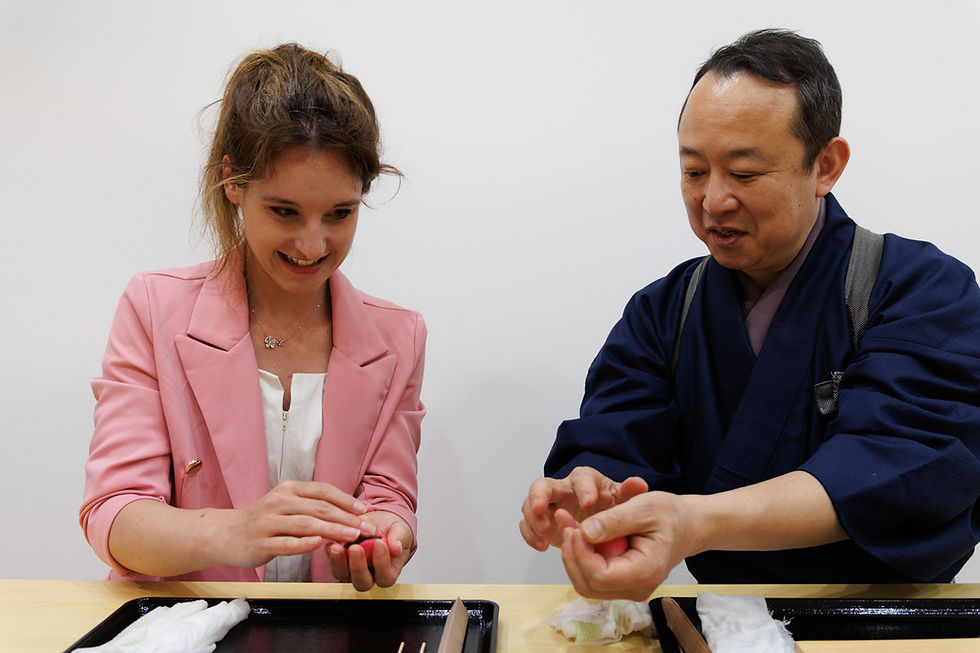
In Kagurazaka, EDO KAGURA offers a wagashi-making experience taught directly by Takeshi Inoue.
Participants learn to shape seasonal jo-namagashi before enjoying what they have made with matcha in Fufumi-an, Baika-tei's traditional tea room.
The experience is supported by EDO KAGURA's specialized cultural guides, trained in Japanese traditional culture, with interpretation available in English, French, Spanish, and German.
For details about the class itself, see our Wagashi Making Class in Tokyo page.
For travelers interested in understanding why wagashi and matcha belong together — and how tea ceremony, Zen, seasonality, and the aesthetics of the tea room are connected — read our guide to Wagashi and Tea Ceremony.
And for those who want to go further, our SHOGUN Cultural Experience in Kagurazaka connects wagashi and matcha with the broader cultural world of Edo. In a traditional tea room, guests can experience wagashi rooted in the same Edo-period culture enjoyed by the shogunate, then listen to the kokyu, a traditional bowed instrument that also flourished during the Edo period. Experiencing these elements in the same place on the same day offers a rare opportunity to encounter the world of the shoguns not as separate museum exhibits, but through taste, sound, craftsmanship, and space.

Tokyo wagashi did not begin in Tokyo.
Its story reaches back through Nara and Imperial Kyoto, through medieval shoguns, Tokugawa Ieyasu and Yoshimune, through the explosive growth of Edo's urban culture, and through the lives of individual confectioners such as Matsuzo and Takeshi Inoue.
That long journey is precisely what makes Tokyo's wagashi culture worth discovering today.

About the Author
Shinya Yamada is the founder and Representative Director of EDO KAGURA, a cultural experience company based in Kagurazaka, Tokyo, where he has lived for over 25 years.
Through EDO KAGURA, he works closely with traditional artisans, performers, and cultural practitioners to create authentic experiences for international visitors. His goal is to help travelers understand Japanese culture not only by observing it, but by experiencing it firsthand.


Comments